Top 5 Fin AI Alternatives for Enterprise Contact Centers in 2026
.avif)

- Cresta is the only platform that automates, augments, and analyzes on one conversation layer, trained on each customer's own data, making it the strongest full-lifecycle alternative to Fin for enterprise contact centers.
- Sierra and PolyAI are the strongest options for voice-first enterprise deployments in this set; Cognigy offers the broadest multilingual footprint.
- Decagon deploys fast on digital channels but is not built for regulated enterprise contact centers, voice volume, or deep operational intelligence.
- The Salesforce acquisition makes Fin's roadmap uncertain. Buyers mid-contract should evaluate alternatives before the deal closes.
- Four criteria separate a chat-deflection tool from an enterprise Customer Experience AI platform: channel coverage, enterprise readiness, conversation intelligence, and handoff quality.
Competitor assessments are grounded in publicly available product pages and third-party reviews as of July 2026.
Fin is one of the strongest AI agents in customer support. It is especially compelling for teams that want fast automated resolution across the customer journey. But it is not the right fit for every contact center, especially now that Salesforce has signed a definitive agreement to acquire Fin. That makes platform direction, CRM dependency, and enterprise operating needs more important in the buying process.
This guide compares the best Fin alternatives for enterprise support and contact center teams. The main question is simple: do you need an AI agent, or do you need a platform that can automate conversations, guide agents, and improve performance across the entire operation?
The best fin ai alternatives in 2026 are Cresta, Sierra, PolyAI, Cognigy, and Decagon, evaluated below on channel coverage, enterprise readiness, conversation intelligence, and handoff quality.
At a Glance: Fin AI Alternatives Compared
Direct comparison of the top fin ai alternatives across the criteria that matter for enterprise contact centers.
How We Chose These Fin AI Alternatives
Buyers who compare containment rates alone will underestimate the handoff and intelligence gaps. Four criteria separate a Fin-replacement chatbot from an enterprise Customer Experience AI platform.
Does It Handle Voice at Enterprise Scale?
Voice coverage is the first filter. Fin was built for chat deflection. In ContactBabel’s 2024 U.S. contact-center benchmark, telephone accounted for 63.7% of live-agent inbound interactions, plus 7.4% through telephone self-service, compared with 7.2% for web chat. Platforms built chat-first often bolt voice on as a secondary capability. Any Fin alternative must handle voice at the scale your operation actually runs.
Can It Hold Up in Regulated Industries?
Enterprise readiness means layered guardrails, adversarial testing, behavioral quality management, audit trails, and versioning that does not require an engineering ticket to push a correction. Financial services, insurance, healthcare, and telco face compliance consequences that ecommerce does not. Evaluate on enterprise readiness, not containment rate.
What Do You Learn After the Automation?
Containment rate is a throughput metric. It says nothing about why customers called, what broke during automated sessions, or how to improve the human agents handling escalations. A full platform analyzes 100% of conversations and links specific behaviors to outcomes the business actually cares about: sales, retention, resolution, CSAT, AHT. Without that layer, you are optimizing a chatbot without understanding your contact center. See how conversation intelligence drives coaching and QM.
What Happens When AI Escalates?
The moment automation fails is where customer experience is won or lost. An automated transfer summary is the floor. Real-time guidance during the escalated conversation, surfacing the right answer before the agent has to search, is what separates platforms that augment human performance from platforms that simply pass the baton. See what Agent Assist delivers after a handoff.
The 5 Best Fin AI Alternatives in 2026
1. Cresta: Best for Enterprise Contact Centers
Summary: Cresta is the strongest Fin alternative for enterprise contact centers that need to automate, augment, and analyze customer conversations in one platform. It combines AI Agent, Agent Assist, and Conversation Intelligence, which makes it a better fit when human agents still handle complex, regulated, or high-value interactions.
Key features:
- AI Agent for automated customer conversations across voice, chat, and SMS in 30+ languages
- Agent Assist for real-time guidance, knowledge answers, workflows, and AI summaries
- Conversation Intelligence for insights, quality management, coaching, and AI Analyst
- 100% conversation analysis across voice and digital channels
- Shared intelligence layer across automation, human agents, QA, and coaching
Cresta’s edge is that it does not stop at deflection. Its AI Agent can take action in CRM, billing, scheduling, and other systems. Its Agent Assist gives human agents real-time guidance during live conversations. Its Conversation Intelligence analyzes 100% of conversations, scores quality, and connects behavior to outcomes like resolution, handle time, and revenue.
What matters:
- Best fit for high-volume enterprise contact centers
- Strong fit for regulated industries like financial services, insurance, healthcare, telecom, travel, and hospitality
- Best when AI and human agents need to improve together
- Better suited to operations leaders than teams buying a simple chatbot
Why it is a good alternative: Fin is an AI agent. Cresta is a contact center AI platform. That difference matters when the goal is not just resolving more tickets, but improving the entire operation.
Awards: Leader in The Forrester Wave™: Conversation Intelligence Solutions for Contact Centers, Q2 2025
Platform independence: Cresta's roadmap is built around contact center outcomes, not CRM consolidation. That distinction carries real weight now that Fin sits inside the Salesforce orbit.
Explore how to choose which conversations to automate
2. Sierra: Best for Brand-Controlled Customer Experience
Summary: Sierra is a strong Fin alternative for enterprise brands that care deeply about trust, tone, and customer-facing AI quality. It is built for companies that want polished AI agents across channels, with a managed partnership model and outcome-based pricing.
Key features:
- AI agents across voice, chat, email, and WhatsApp
- Support for 59 languages
- System-of-record integrations for tasks like returns, claims, and mortgage origination
- Built-in testing, monitoring, and performance visibility
- Ghostwriter and Explorer for agent changes and analytics
Sierra’s public product page emphasizes branded experiences, complex use cases, weeks-to-launch deployment, and pricing tied to specific outcomes. It also says 40% of the Fortune 50 partner with Sierra.
What matters:
- Best fit for premium consumer brands
- Strong when brand voice and trust are central
- Good fit for CX teams that want a high-touch vendor partner
- Buyers should validate native QA, coaching, and post-handoff agent support before replacing a contact center platform
Why it is a good alternative: Sierra is a good Fin alternative when customer-facing AI quality is the top priority. It is less compelling when the buyer needs a full operating layer for agent performance, QA, and coaching.
3. PolyAI: Best for High-Volume Voice Automation
Summary: PolyAI is the best Fin alternative when the problem is voice volume. It is built around enterprise dialog agents, not chat-first support, and its strongest use cases include authentication, call routing, billing, bookings, order management, and troubleshooting.
Key features:
- Voice-first AI agents for phone-based service
- Agent Studio for building and iterating dialog agents
- Enterprise guardrails for compliance, brand, and experience
- Industry coverage across healthcare, hospitality, insurance, retail, telecom, travel, and utilities
- Per-minute pricing for ongoing voice agent usage
PolyAI’s pricing page says ongoing use is billed per minute and includes proactive performance improvements, maintenance, and 24/7 support. It also lists a 99.9% uptime SLA for phone lines.
What matters:
- Best fit for call-heavy enterprises
- Strongest when replacing IVR or automating inbound phone volume
- More specialized than broad customer support platforms
- Buyers should test digital workflows, post-handoff support, and analytics depth if those are major requirements
Why it is a good alternative: PolyAI is a strong alternative when Fin is not voice-native enough for the use case. If the business case is call containment, PolyAI belongs on the shortlist.
4. Cognigy: Best for Multilingual and Global Enterprise Deployments
Summary: Cognigy is the best Fin alternative for multinational enterprises that need multilingual automation across voice and chat. Its AI agents work in phone and chat support, are available 24/7, and support 100+ languages.
Key features:
- AI agents for phone, voice, chat, and messaging
- 100+ language support
- AI Agent Studio, Knowledge AI, Voice Gateway, and Agent Copilot
- Contact center integrations with platforms like Genesys, NICE, Avaya, AWS, Microsoft, and 8x8
- Enterprise compliance positioning across GDPR, SOC 2, HIPAA, and other frameworks
Cognigy’s documentation shows a more modular pricing structure: billable conversations for Cognigy.AI, concurrent lines for Voice Gateway, and separate licensing for Knowledge AI usage.
What matters:
- Best fit for global contact centers
- Strong for multilingual support and regional complexity
- Better for enterprises with IT and operations capacity
- Buyers should evaluate setup effort and whether analytics are tied to business outcomes, not just conversation reporting
Why it is a good alternative: Cognigy is a strong Fin alternative when global coverage and multilingual scale are non-negotiable. It is less clean for teams that want a simpler platform with built-in performance management.
5. Decagon: Best for Digital-Native, Lower-Complexity Support Operations
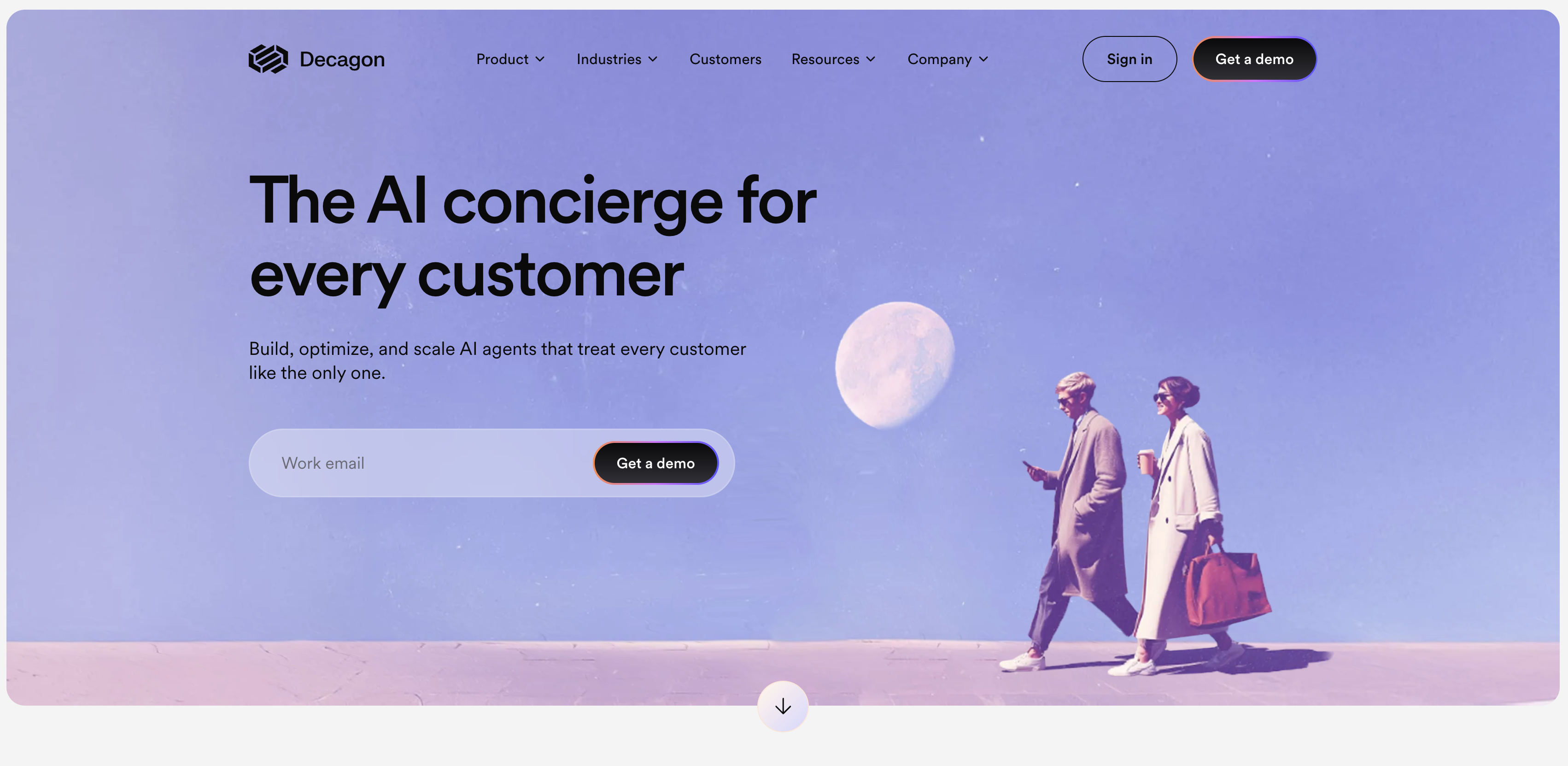
Summary: Decagon is a strong alternative for digital-first companies that want to build, test, and improve AI agents quickly across chat, voice, and email. Its homepage emphasizes natural-language Agent Operating Procedures, testing, observability, experimentation, reporting, and rapid iteration.
Key features:
- AI agents for chat, voice, and email
- Agent Operating Procedures for workflow definition
- Testing, QA, Watchtower, insights, and reporting
- Natural-language workflow iteration
- Per-conversation and per-resolution pricing options
Decagon says most customers choose per-conversation pricing, although it also supports per-resolution pricing. The company argues per-conversation pricing is more predictable and avoids disputes over what counts as a successful outcome.
What matters:
- Best fit for SaaS, ecommerce, travel, retail, and digital-first support teams
- Strong when speed and workflow iteration matter
- Good for teams that want modern AI support without heavy internal AI buildout
- Less obvious for highly regulated, voice-heavy enterprise contact centers
Why it is a good alternative: Decagon is a good Fin alternative for teams that want fast AI agent iteration across digital support workflows. It is not the first pick when agent coaching, 100% QA, and regulated enterprise operations are the core requirements.
Which Fin AI Alternative Is Right for Your Contact Center?
The right platform depends on whether you are replacing a chatbot or building a full Customer Experience AI operating model. Those are different purchases with different consequences.
You need voice AI at enterprise scale. Cresta or PolyAI. PolyAI leads on pure voice deflection where that is the singular goal. Cresta leads when you also need augmentation during escalation and outcome-linked analytics. In a regulated industry, Cresta is the stronger call.
You need multilingual coverage or operate globally. Cognigy or Cresta. Cognigy has the deeper localization layer and a strong regional compliance record. Cresta brings outcome intelligence and a closed-loop augmentation layer that Cognigy does not appear to match natively.
You are in financial services, insurance, healthcare, or telco. Cresta. Regulated industries need enterprise guardrails, 100% QM for compliance evidence, and an augmentation layer that keeps human agents performing well on the escalations automation cannot handle.
You are a digital-native brand replacing a basic chat deflection tool. Decagon or Sierra for lower-complexity, lower-volume use cases. If you expect to scale into voice, add a coaching and QM layer, or extend into regulated verticals, start with Cresta to avoid re-platforming in 18 months.
Platform independence is a factor. All five platforms are independent of the major CRM vendors. With Fin now in the Salesforce orbit and a Service Cloud consolidation trajectory plausible, that independence carries real weight in a multi-year contract.
See the four conversation types that determine what to automate.
The Right Question Is Not Which Chatbot Has the Highest Containment Rate
If the Salesforce acquisition has you re-evaluating Fin, start here: Fin was built for chat deflection. The alternatives that serve enterprise contact centers best do not stop at deflection. They automate the right conversations, augment human agents on the rest, and give you the intelligence to improve both. One platform, not three disconnected tools.
Cresta runs that full loop on a single conversation layer, trained on your own data, with a roadmap built entirely around contact center outcomes. That is the structural difference a CRM acquisition cannot replicate.
See how Cresta handles all three.
Cresta is dedicated to helping businesses of all sizes make informed decisions. We adhere to strict editorial guidelines to ensure that our content meets and maintains our high standards.
FAQ
What are the best alternatives to Fin AI in 2026?
Which Fin AI alternatives handle both voice and chat?
What should I look for when switching from Fin AI?
Related guides



AI Agents for Customer Experience: The 2026 Enterprise Buyer's Guide to Production-Ready AI
An AI agent for customer experience is software that autonomously handles full customer conversations across voice, chat, and digital channels using large language models, resolving multi-step, multi-intent issues end to end without human intervention.