

Customer experience agents have always learned on the job: in live conversations, with real customers. If difficult calls came in and an agent wasn’t ready for that particular question, they would have to stumble through, leaving a poor customer experience and potential brand damage in their wake.
But this model has a true operational cost on the business. Every new agent who struggles through long onboarding, every difficult call handled before an agent is ready, and every coaching gap that goes unaddressed quickly shows itself in longer time-to-competency, higher early-stage attrition, inconsistent compliance, more escalations, and a blow to customer experience.
Training teams have tried to reduce the risk of learning in real time, but traditional alternatives have only gone so far. E-learning tools can teach policies and processes, but they fall short of mimicking the meandering, and sometimes messy, experience of a live customer conversation. Manager-led role-play is more interactive, but difficult to scale and execute consistently. Today’s simulation training tools put the onus on leaders to manually build static scripts and branching paths, which require time and resources to build out and rapidly become outdated.
Today, Cresta is closing that gap with Training Simulator: an agentic AI training environment that gives agents a place to practice against simulated customers, built off of actual customer conversations.
Training Simulator Under the Hood
Instead of relying on static training content, generic practice exercises, or one-size-fits-all scenarios, Training Simulator gives agents a realistic environment to build skills before they are in front of a customer.
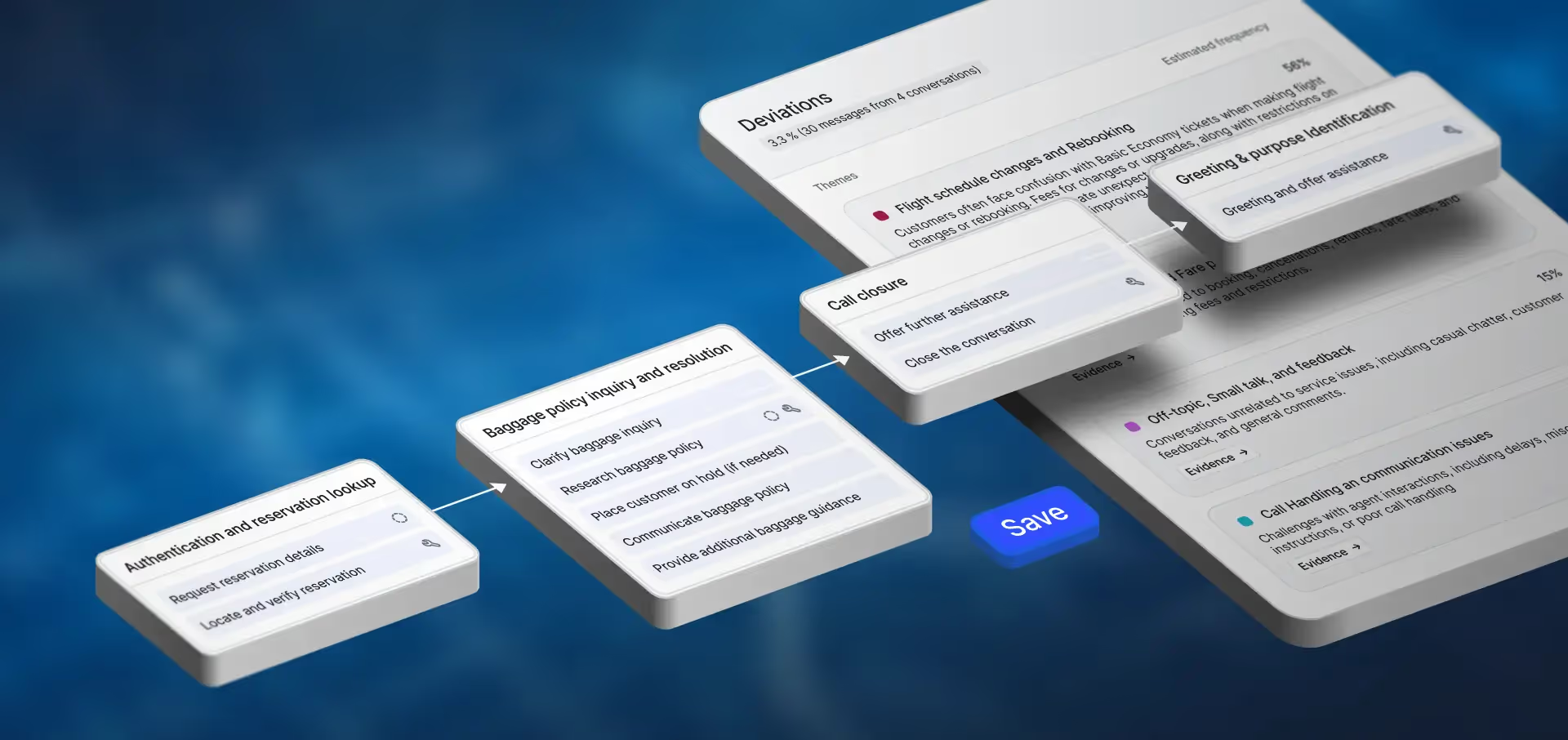
An agent launches a scenario, and has a real conversation with a simulated customer, powered by Cresta’s AI Agent technology. These simulated customers respond dynamically to what the agent says, push back on weak answers, show frustration when presented with generic answers, and escalate if an agent loses control of the conversation. What makes this different isn’t just the realism of the situation, but the way the entire training workflow is built. Leaders can create new scenarios from a prompt, informed by insights from real-world conversations already in the Cresta platform, rather than relying on hand-built branching trees. This allows training programs to evolve as quickly as the business does.
Four Ways Training Simulator Turns Practice Into Performance
Realistic simulated customers
Traditional approaches to training often break down because agents practice against scenarios that are too predictable, or that rapidly grow stale. Real customers don’t follow a script: they interrupt, push back, get frustrated, change topics, and, potentially, expose gaps in an agent’s confidence or judgment.
Training Simulator gives agents a more realistic environment to practice in. Simulated customers can be built with insights from real conversations surfaced by Cresta Insights and powered by the same AI Agent technology Cresta uses in live deployments. They respond dynamically, show emotion, and push back on weak answers. For example, an agent practicing a cancellation save will face a simulated customer who believably objects to retention offers and escalates when answers feel generic.
Build & validate scenarios quickly & efficiently
To actually drive performance, training content must keep pace with the business. But the reality is that in most contact centers, building new scenarios is slow, manual, and difficult to scale across product launches, policy changes, compliance updates, and the business’ evolution.
With Training Simulator, Learning & Development leaders can build scenarios from a simple prompt. Turnaround time is fast; users can stand up a new scenario for an upcoming product launch or policy change in an afternoon. Scenarios can then be validated against live quality criteria before publishing.
Graded on the same criteria as real conversations
Practice loses value when agents are evaluated one way in training and another way once they are on the floor, live with customers. That disconnect makes it harder for agents to understand what good looks like, and harder for leaders to know whether training is actually improving performance.
Training Simulator uses the same AI-powered quality criteria that evaluate actual customer conversations to grade simulated ones. It goes beyond keywords and phrases, recognizing and evaluating dynamic, contextual behaviors. What agents practice maps directly to how they'll be evaluated on the floor, keeping everyone on the same page with standardized expectations.
Integrated directly into coaching plans
Simulations are most valuable when they are deeply integrated into the performance management systems managers already use. If they only ever exist in a silo, they may be useful in theory, but make it hard for teams to assign, track, and reinforce behaviors that actually need to change.
Through Training Simulator, scenarios can be tagged to specific agent behaviors, managers can assign targeted simulations to individual agents based on their performance, and the results surface in the same coaching plan the manager already works from. Skills flagged in a coaching session become the assigned scenario, targeting the exact behaviors and skills an agent most needs to improve.
Where Training Simulator Has the Most Impact
Onboarding. New agents have the opportunity to practice in a safe environment against simulated customers before ever taking live calls. They hit the floor having already navigated hard conversations, objections, and compliance-sensitive moments. This both reduces ramp time for new agents, and helps ease early attrition risk at the same time.
Upskilling. When change occurs in the contact center, whether in the form of an agent moving into a different department, or an organization-wide change to product, pricing, or policy, managers can drop agents into tailored courses designed to get them up to speed quickly. With Training Simulator, agents can practice and make the mistakes in an environment where a poorly executed sales pitch or a compliance breach won’t result in real consequences for the business, and managers gain peace of mind that their agents are actually ready to field live conversations.
Remedial coaching. A manager flags a specific behavior in QM, but rather than telling an agent what they did wrong and hoping it sticks, they can assign a simulation that targets exactly that behavior. The agent practices it and progress is tracked in the same coaching environment, allowing coaching feedback to go beyond conversation to structured practice.
The Bottom Line
Every live conversation an agent has before they're ready is a customer experience you can't get back.
Training Simulator gives agents a place that behaves like a real conversation to make their mistakes before those mistakes have consequences. They can practice the conversations that matter most and receive feedback based on the same criteria used to evaluate real interactions. Managers gain a more targeted way to reinforce coaching, L&D teams can keep training aligned to business change, and leaders get a clearer path to measurable performance improvement.
Organizations gain faster readiness for new hires, more consistent execution across teams, stronger coaching follow-through, and better customer experiences when it matters most.
Agents will always learn on the job. Now they have somewhere else to learn first.
See Training Simulator in action: request your personalized demo today!