
The Top 8 AI Agent Platforms for Insurance Contact Centers in 2026
.avif)

- The platforms need to withstand catastrophe surges, open enrollment peaks, cover after-hours demand, and flag suspected fraud
- Test each platform's surge handling, channel coverage, and NAIC compliance posture
- See what context a human agent gets when the AI agent hands off a denied-claim, total-loss, or beneficiary conversation
- A unified platform for AI and human agents offers a more consistent claims experience
Insurance contact centers experience catastrophic volume spikes in short, unpredictable windows.
For example, CoverME.gov's 2026 Open Enrollment Overview Report found that Maine's marketplace averaged 504 daily assistance calls during open enrollment, then took 1,859 on December 15, a 95% year-over-year increase.
An AI agent platform can hold up during these surges, handles claims conversations empathetically, and keeps the human agent informed after handoff addresses compliance and retention at once.
But these platforms aren’t created equal.
To help you evaluate and pick the best AI agent solution for your insurance contact center, we’ll break down the top options by their key features, pros and cons, and best use cases.
Note: The information below is accurate as of 9/10/2026 and is subject to change.
Our methodology and evaluation criteria
We’ve evaluated AI agent platforms against the operating conditions insurance contact centers actually face during catastrophe surges, open enrollment peaks, and complex claims conversations.
Each platform is assessed on the same set of criteria below so you can make comparisons more easily.
- AI agent scope: Voice, digital, and multi-agent coverage across first notice of loss, claims status, policy changes, and beneficiary conversations
- Fraud detection: Whether the AI agent flags suspicious first notice of loss or claims activity for investigation
- Post-handoff support: What the receiving agent sees and receives in real time after AI escalates a denied claim, total loss, or beneficiary conversation
- Quality management: Whether scoring covers 100% of AI and human interactions and preserves records a market conduct exam would require
- Deployment reliability under surge load: Safeguards, testing rigor, and observed behavior during catastrophe spikes and open enrollment peaks
- Regulatory and compliance posture: Alignment with NAIC Model #900 and the AI Model Bulletin, plus data security and PII handling
- Language coverage and integration footprint: Per-language transcription accuracy and policy/claims system integration paths
As we evaluated each vendor across this criteria, we pulled in sources from their documentation and case studies, and we looked at their profiles on third-party review platforms (G2, Capterra, Gartner Peer Insights) and analyst reports.
The best AI agent platforms for insurance contact centers
The table summarizes each platform's scope and where it fits. Every entry below follows the same structure, and every entry, including Cresta's, carries real cons and a real limitations note.
1. Cresta
Cresta serves many of the leading insurance carriers, including Mutual of Omaha, Mapfre, AAA Life Insurance, and Penn Mutual, through AI Agent, Agent Assist, and Conversation Intelligence.
Pros:
- AI Agent handles complex voice and digital work, then transfers context to Agent Assist for real-time human-agent guidance
- Conversation Intelligence analyzes 100% of conversations across human and AI agents for coaching and performance insights
- Can showcase real customer proof points. Case in point: A Fortune 500 insurance and financial-services carrier reported a 7% direct-mail revenue increase and a forecasted $5 million-plus benefit at full scale
- Access best-in-class support. For example, Mutual of Omaha's Laif Wheeler said "challenges mean nothing" to the Cresta team working on their account
- Leverage a multilingual, multi-model architecture and 20+ pre-built CCaaS integrationsCresta is a recognized Leader in The Forrester Wave™: Conversation Intelligence Solutions for Contact Centers, Q2 2025, with the highest Current Offering score of any vendor evaluated
Cons:
- Pricing is quote-based and aimed at large operations
- Smaller carriers should confirm commercial fit, deployment timing, and insurance-specific references beyond the single named carrier case study above
Limitations: If you’re First Notice of Loss (FNOL)-only, you should compare its scope and cost with lighter alternatives.
Best for: Large carriers and insurance business process outsourcing providers needing automation, augmentation, and unified QM.
Get a closer look at how Cresta's AI agents for insurance can work by testing them.
2. Cognigy (NiCE CXone Mpower)
Cognigy supports enterprise voice automation and IVR replacement by offering Voice Gateway for telephony orchestration at contact-center scale, a hybrid rule-based and LLM architecture for structured yet natural-language self-service, and support for 100+ languages.
It’s worth noting that NICE recently closed its ~$955 million acquisition of Cognigy (September 2025), but Cognigy continues independent deployment alongside a documented beta integration with NiCE CXone.
Pros:
- Pre-built insurance AI agents cover FAQs, identity verification, first notice of loss, claims processing, document collection, underwriting, and e-signatures

- An anonymized Fortune 500 insurance company case study documents a 15% reduction in average handle time after automating IVR and identity verification
- Cognigy's NLU supports over 100 languages, with prebuilt entities in 28, per its 2026 release, plus Agent Copilot and live chat for human-agent support
- On-premises and dedicated hosting support data-residency requirements
Cons:
- You’ll need to determine whether pricing fits a non-NiCE telephony stack and whether Nodes-and-Intents can support dynamic claims workflows
- Unified QM spanning AI and human interactions isn't confirmed for Cognigy specifically; the closest coverage sits under NiCE's broader CXone Mpower QM offering. No named insurance carrier customer exists, and on-premises Kubernetes deployment requires "significant additional configuration effort," per Cognigy
Limitations: Carriers committed to a non-NiCE stack should assess how NiCE ownership may affect roadmap independence and integration choices.
Best for: Large carriers modernizing legacy IVR where voice is the dominant channel.
Related: A guide to Cognigy alternatives
3. Sierra
Sierra is an enterprise AI agent platform built around goals, guardrails, and supervisory oversight, with Live Assist generally available as a human-agent support layer after handoff.
Pros:
- In January 2026, partner Stellarus deployed Sierra's AI agents for Blue Shield of California, highlighting the platform’s scalabilitySupervisory agents verify factuality and enforce policy with every response, and Sierra has published adversarial voice simulation testing that stress-tests agents before they reach customers
- Deterministic rules let carriers hard-code policy boundaries as claims conditions change, and Live Assist supports human agents after escalation
Cons:
- Sierra's Insights suite analyzes AI agent conversations only; carriers needing examination-ready QM across human agents too will need a separate layer
- Its outcome-based pricing has no published tiers or figures, so model normal- and catastrophe-month costs directly with Sierra
- The named health-plan reference covers a health plan rather than a property/casualty or life carrier, so if you’re in those lines you need to request a closer reference

Limitations: Confirm whether Live Assist and human-interaction quality management meet post-handoff and examination requirements.
Best for: Carriers that want AI agent automation with supervisory controls and generally available Live Assist.
Related: A guide to Sierra alternatives
4. Decagon
Decagon is an AI agent platform for customer service automation across voice, chat, and email.
Teams configure agent behavior using Agent Operating Procedures in natural-language Its companion Watchtower product also reviews AI and human conversations for quality.
Pros:
- Decagon supports voice, chat, and email in one omnichannel platform
- Agent Operating Procedures (AOPs) let teams define agent behavior in natural language rather than custom code
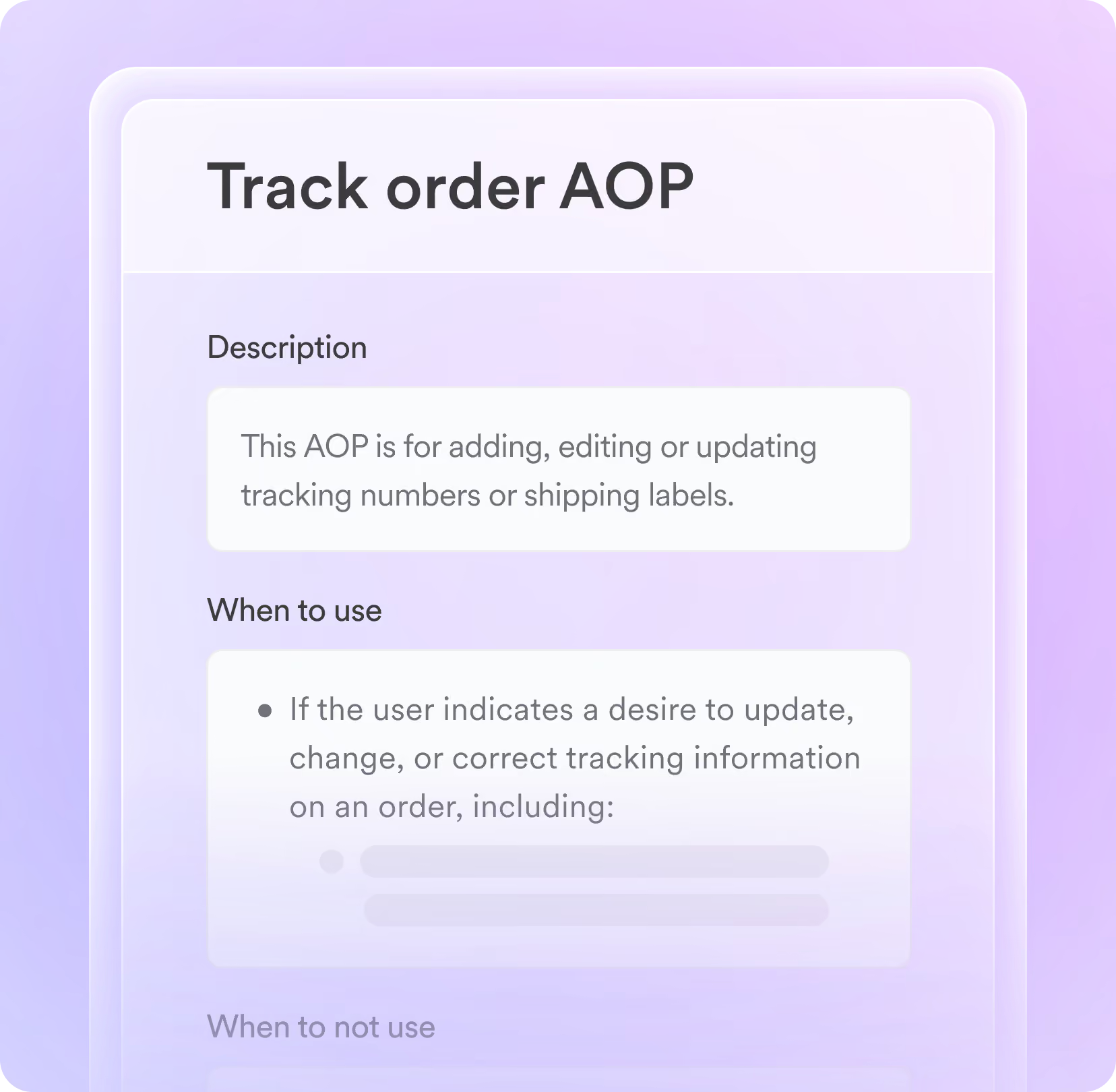
- Watchtower reviews every conversation, AI or human, against customizable criteria, rather than covering only AI-agent or ticket-based interactions
Decagon supports more than 70 languages with automatic detection and switching, and its voice product handles accents and background noise typical of live calls
Cons:
- Decagon has not published a named insurance carrier customer or an insurance-specific result, so carriers should request claims-specific references before a pilot
- Multi-agent orchestration for dividing complex claims conversations across specialized agents isn't clearly demonstrated, and Watchtower's voice-channel scoring depth is unconfirmed
Limitations: Decagon has announced Assist, a real-time human-agent guidance product, for Zendesk deployments specifically; Decagon may need a separate product for live agent guidance outside of Zendesk.
Best for: Carriers with engineering capacity evaluating voice, digital, and multi-agent requirements.
Related: The best Decagon alternatives
5. Google Cloud's Dialogflow CX
Google Cloud's Dialogflow CX is Google's developer platform for building conversational agents, which carriers pair with Vertex AI's Gemini models and Google Agent Assist for real-time human-agent support.
Pros:
- Dialogflow CX (branded as Conversational Agents) provides natural language understanding, intent classification, and state-based workflow design that the carrier configures directly, with direct access to Gemini models for generative responses
- Carriers already standardized on Google Cloud gain direct control over data residency and model configuration by building on Dialogflow CX and Vertex AI rather than working inside a packaged application layer
- Insurance carriers like SIGNAL IDUNA and Generali Italia have built Google Cloud AI knowledge assistants and policy-information tools on Vertex AI, though these are knowledge-retrieval deployments rather than full contact-center AI agent deployments
Cons:
- Google Agent Assist now sits inside Gemini Enterprise for Customer Experience, a retail-only product; carriers should confirm with Google whether Agent Assist is still available and supported standalone, since public documentation doesn't clarify this
- No case study documents Dialogflow CX-based contact-center automation for an insurance carrier with quantified containment, handle-time, or CSAT results
Limitations: Carriers should confirm Google's roadmap and support commitments for non-retail use cases directly with Google Cloud.
Best for: Google Cloud-standardized carriers with strong engineering capacity willing to build directly on Dialogflow CX and Vertex AI rather than buy a packaged application.
6. Kore.ai
Kore.ai is a no-code conversational AI platform for building voice and chat AI agents, marketed as the XO Platform.
Pros:
- A national insurance provider has had 50,000 AI-handled sessions, a roughly 45% self-service resolution rate, $221,000 in realized operational value, and $1.06 million in projected value through December 2026, inside what Kore.ai describes as a regulated environment

- A case study with a major North American healthcare payer documents 40% lower operational costs and multilingual English/Spanish voice AI with Deepgram-powered transcription, agent assist, and conversation-intelligence summarization
- The XO Platform includes multi-agent workflow support alongside no-code configuration tools, and supports building virtual assistants in more than 100 languages after training in one
Cons:
- Agent AI offers coaching, next-best-action guidance, and summarization rather than a dedicated post-handoff product for insurance, so you should verify depth for denied-claim and total-loss escalations
- The 100% voice-and-chat QM scoring claim isn't confirmed as insurance-specific, so you should confirm coverage for their channel mix
Limitations: Configuration scope varies, so you’llneed to validate the exact product mix.
Best for: Carriers prioritizing no-code workflow design across voice, digital, and multilingual AI agent use cases, with a documented production result to benchmark against.
Related: The top Kore.ai alternatives
7. Forethought
Forethought is a customer support automation platform built around ticket-based workflows, and was recently acquired by Zendesk.
Its suite spans ticket resolution (Solve), human-agent assistance (Assist), quality management (Agent QA), and workflow discovery (Discover), plus a newer AI Voice Agent channel extending beyond tickets into live voice.
Pros:
- Forethought Assist includes AI Chat Assistance, Guided Ticket Resolution, and Ticket Response Suggestions, and escalations preserve full AI interaction context for human agents
- Agent QA automatically evaluates 100% of support interactions across chat, email, and voice, not only ticket-based channels
- Discover and autoflows identify candidate workflows and help teams build service automation
Cons:
- Forethought doesn’t publish a named insurance carrier customer or an insurance-specific result
- The platform-wide stats it cites, such as an 84% average resolution rate and 1.2 billion monthly interactions, aren't attributed to insurance clients specifically, so carriers should validate real-time voice performance against their own denied-claim and total-loss scripts before a pilot

Limitations: Determine whether Conversation Intelligence connects human-agent behavior with claims outcomes, retention, and resolution.
Best for: Carriers whose service model centers on tickets and digital workflows rather than high-volume voice claims operations.
8. Observe.AI
Observe.AI is primarily a quality management and Conversation Intelligence platform with voice and chat AI agent products, and the only platform here with more than one named, quantified insurance customer.
Pros:
- Observe.AI has three case studies from insurance customers: Trupanion, American National Insurance, and and an unnamed homeowners insurer

- Real-time agent assist supports human agents during active conversations, not just post-call review, and VoiceAI plus ChatAI cover both telephone and digital automation.
Cons:
- Confirm ChatAI's digital-channel depth alongside VoiceAI, and test whether Observe.AI's Insights product ties coaching opportunities to claims, retention, or bind-rate outcomes as tightly as a dedicated outcome-inference model
- None of Observe.AI's insurance case studies include a date, so carriers should confirm currency directly with the vendor
Limitations: If you require multi-agent orchestration and no-code workflow depth should validate those capabilities.
Best for: Carriers prioritizing focused quality management and real-time human-agent assistance..
Related: A look at Observe.ai alternatives
Test Cresta AI Agent for insurance before you commit
The claims this guide makes about Cresta are testable in a scoped pilot, not a slide deck: AI Agent behavior under surge load, transcription accuracy against your policyholder language mix, integration against live policy and claims data, and Agent Assist guidance quality on escalated claims.
Browse the Cresta resource library for case studies, or request a demo to see how Agent Assist supports human agents after denied-claim, total-loss, and beneficiary escalations.