
How to Build a Business Case for Contact Center AI


- A business case for contact center AI wins budget when it proves value in your own numbers, not vendor averages, and speaks to every stakeholder on the buying committee.
- Most cases stall because the baseline is borrowed, the costs are understated, and the benefits float free of any specific workflow or agent behavior.
- Finance checks net return on investment, payback period, and annual net benefit before it trusts anything else, so lead with those three numbers and the scenarios behind them.
- A scoped pilot on live traffic proves the case in weeks, moving from conversation analysis to agent assistance to automation as each phase earns the next.
A business case for contact center AI has to do more than show the technology works. It has to win budget from a room that has watched automation projects underdeliver before, which means convincing finance, operations, security, and customer experience leaders at the same table. If you are the person inside the organization who already believes in the project, the vendor demo is the easy part. The hard part is the internal sell, and that is where good ideas quietly die.
The internal sell is also where the numbers say most purchases break down. Forrester's State of Business Buying report for 2024 found that 86% of B2B purchases stall during the buying process, and 81% of buyers end up dissatisfied with the provider they finally chose. This guide is written for the internal champion, the contact center or customer experience leader carrying an AI project through a cross-functional buying committee. It covers what your case has to prove and who it has to convince, why cases stall, the six moves that make one finance can fund, and the mistakes that sink it before the vote. Done well, it turns a skeptical committee into a funded mandate.
What a contact center AI business case has to prove (and who it has to convince)
A contact center AI business case has to prove two things at once, that the money math holds and that every function with a stake can live with the plan. Scrutiny lands on the money first. A Gartner survey of 782 infrastructure and operations leaders, published in April 2026, found that only 28% of AI use cases fully meet their return on investment (ROI) expectations, while 20% fail outright. Finance has read numbers like those, so the champion walks in already carrying the burden of proof.
Proving it means translating an operational pitch into the language each stakeholder speaks. Finance verifies the math, but operations, IT, security, and customer experience each hold a different veto over the same case. A business case that answers only the finance question passes one desk and stalls at the next, so winning the room starts well before the presentation.
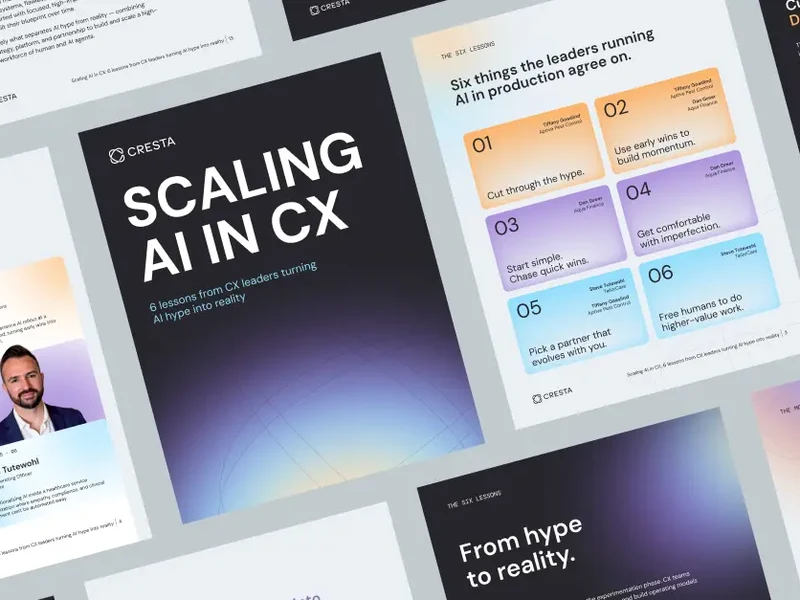
Get hard-earned lessons from CX leaders
Why most contact center AI business cases stall
Most contact center AI business cases stall for reasons that have nothing to do with the technology and everything to do with how the case was built. A 2025 S&P Global study found that 42% of companies abandoned the majority of their AI initiatives before seeing value, up from 17% the year before. The pattern behind those abandonments repeats across contact center cases in a few predictable ways.
- Borrowed baselines: The model uses an industry average cost per contact instead of the organization's own loaded number, so finance discounts the savings from the first line.
- Hidden costs: Setup, integration, retraining, and program management never reach the math, which means the payback date is wrong before anyone reviews it.
- Unattributed benefits: A value figure floats free with no specific workflow or agent behavior behind it, and finance cannot trace it to anything it can verify later.
- Mixed savings: Hard savings that hit the profit and loss sit in the same total as soft satisfaction gains, so the whole number reads as optimistic.
Each of these is a self-inflicted wound, fixable before the case reaches a vote.
6 ways to build a business case for contact center AI
Building a fundable business case comes down to six moves. The first four build the numbers, organized like an ROI workbook with a baseline tab, a benefit tab, a cost tab, and a summary. The last two build the coalition that has to approve them.
Baseline your own cost to serve, not industry averages
Every savings number downstream depends on your current cost per contact, and only a baseline pulled from operational data survives a finance review. Build the first tab from automatic call distributor exports, payroll records, and workforce management reports, not from a benchmark someone published. Your fully loaded cost per contact includes agent salary, benefits, overhead, telephony, software, and the supervisory ratio behind each conversation, and it moves by channel and complexity, so a chat and a complex voice call do not cost the same.
Sampling is the weak point. When a quality management (QM) program reviews only the industry standard of 1 to 2% of conversations, the volume, handle time, and topic mix in your baseline rest on estimates the committee can challenge. CVS Health moved from scoring 5% of calls to 100% with Cresta Conversation Intelligence, which turns a sampled guess into a measured baseline the model can defend.
Model the value levers that move profit and loss
A pilot dashboard that reports only deflection makes the investment look smaller and riskier than it is. Model value across four levers so the case does not ride on containment rate alone. Each lever maps to a formula block on the benefit tab, and each one has customer evidence behind it.
- Containment and deflection: Count only conversations an AI agent resolves end to end, not calls a customer abandoned, then price the gap between assisted and automated cost. Snap Finance lifted containment from 6% to 33% with Cresta AI Agent, a 5.5x improvement.
- Agent productivity and handle time: Real-time help for human agents cuts average handle time (AHT) and after-call work on the volume automation does not touch. The study Generative AI at Work, published in the Quarterly Journal of Economics in 2025, tracked 5,179 support agents and found a 15% average productivity gain, and United Airlines cut AHT 15% with Cresta Agent Assist.
- Revenue: Real-time hints that prompt human agents to upsell change conversion in measurable ways. Cox Communications raised revenue per chat by 20 to 30% in residential sales when agents followed guidance during live conversations.
- Quality coverage: Scoring every conversation builds an efficiency case and a compliance case at the same time. Brinks Home cut quality management costs by half after moving to full coverage.
Model each lever conservatively against your own rates, and keep gross revenue out of the summary until it is risk-adjusted.
Cost it honestly with total cost of ownership
Software licensing covers only part of year-one contact center AI cost, and a case that shows only license fees reads as a sales deck. The cost tab has to carry setup, integration, data preparation, training, change management, and the internal administrator time to run the program. Some are one-time outlays and some recur, so separate them, because the payback math needs the one-time cost at month zero and the recurring cost in every year after.
Retraining is the line most models leave out. Plan for periodic model tuning and human review of AI output rather than a one-time build, since those keep total cost of ownership (TCO) above the license line long after launch. Teams that skip the full cost are the ones that report first-year budget overruns, the credibility hit a champion cannot afford in front of the committee.
Lead with the three numbers finance verifies
At the first review, finance scans three numbers before it hunts for a weak cell, net ROI percentage, payback period, and annual net benefit. Net ROI percentage is annual net benefit divided by annual cost. Payback period is the month the cumulative cash flow turns positive. Annual net benefit is gross benefit from the levers minus TCO. Wire the summary tab to pull only from the tabs before it, so every number traces back to a source cell.
Then show the range. Run the model through conservative, moderate, and aggressive assumption sets, and apply a 20 to 30% risk haircut to gross savings before they reach the summary. Set payback expectations carefully, because Deloitte's 2025 AI ROI Paradox study of 1,854 senior executives found only 6% of companies achieve payback within one year, with most reporting satisfactory ROI in the two to four year range. A stated range earns a warmer reception than a single confident number, and the aggressive case argues for expanding the investment later.
Align the buying committee before you present
The fastest way to lose a business case is to let one concern surface for the first time in the room where the decision gets made. A contact center AI purchase touches five functions at once, and each one can stall the deal if the case does not speak to it. Meet each stakeholder beforehand and fold what they need into the model.
- Finance needs traceable inputs, a conservative scenario, and payback and net ROI figures it can defend upward.
- Operations owns the baseline volumes, handle times, and capacity assumptions, and needs freed capacity reallocated to a named purpose rather than vague savings.
- IT needs to know which systems integrate, whether connections run real time or batch, and what the deployment actually requires from its team.
- Security and compliance need data residency, access controls, and evidence such as a SOC 2 Type II report, treated as pass or fail rather than a preference.
- Customer experience needs proof that automated and assisted conversations hold or improve customer satisfaction (CSAT), not just that cost drops.
When each function sees its concern already answered in the model, the presentation stops being a negotiation and becomes a confirmation.
Prove it with a scoped pilot, not a promise
A business case built on projections gets stronger the moment it includes a plan to prove itself on live traffic. A scoped pilot answers the committee's real question, whether the model holds up on your own queues, and it does so in weeks rather than the six months a traditional evaluation can consume. Capture baselines before the AI touches anything, then move through three phases where each one earns the next.
Start by scoring 100% of real conversations to set the baseline and identify which flows are stable enough to automate. Next, let AI support human agents in real time while humans keep every action, which validates the flows under real conditions. Automate the proven flows last, once the evidence is in hand.
Cresta's three products are AI Agent (Automate), Agent Assist (Augment), and Conversation Intelligence (Analyze), and they map onto that order. Cresta Conversation Intelligence scores every conversation and its automation discovery capability flags which use cases are ready, Cresta Agent Assist carries the real-time support phase, and Cresta AI Agent takes the proven flows end to end.
A first live use case in roughly twelve weeks gives the champion measured results, not a promise, to bring back to the committee. Looking to get started? Connect with our team to start a scoped AI Agent pilot on your own queues, or request a conversation assessment to see where your baseline stands today.
Mistakes that sink a contact center AI business case
The model can be sound and the case can still fail on execution. Most of these mistakes happen in how the champion defends the case, not in the spreadsheet.
- Leading with the aggressive number: Opening on the best-case ROI invites finance to spend the meeting attacking it. Lead with the conservative scenario and let the upside argue for more investment.
- Promising headcount cuts: Framing savings as eliminated positions triggers resistance and rarely matches how these projects get funded. Present freed capacity as absorbed volume growth or unbackfilled attrition instead.
- Hiding the risks: Saying nothing about model tuning, adoption, and integration reads as inexperience. Name the risks first and bring a mitigation for each.
- Bringing security in late: A data or compliance objection raised after the model is built can restart the whole cycle. Pull IT and security in during drafting, not at the vote.
- Presenting one number instead of a plan: A single confident figure with no pilot behind it asks the committee to trust a projection. A phased pilot with go and no-go gates asks them to fund a test, which is a far easier yes.
Clear these five before the case goes in front of the committee, and the champion walks in defending a plan rather than a guess.
Give your champion the numbers to lead the charge
A business case for contact center AI is won or lost on whether the numbers hold up under people who have reasons to doubt them. The champion who baselines in real data, models value by lever, costs the full program, and brings a scoped pilot walks into the committee with evidence instead of enthusiasm.
The evidence gets far easier to defend when the baseline and the post-launch results come from the same measurement layer. When the numbers that won approval are the ones tracked against actuals each quarter, the champion never has to explain a gap between the forecast and the report.
Cresta Conversation Intelligence measures your baseline and post-launch results from one auditable layer, so projected ROI becomes finance-ready actuals rather than a claim. Browse the Cresta resource library for guides on building the case, or request a demo to see how it keeps your assumptions verifiable after launch.
.jpg)


