
What High-Performing Contact Centers Do Differently With AI


- Contact center transformation delivers durable AI results when leaders fix the operating model around the tool, not when they add more features.
- Unified conversation data separates strong deployments from stalled ones, because analysis, real-time guidance, and coaching all depend on the same record.
- Customer-confirmed resolution belongs at the top of the reporting hierarchy, while containment stays in operating reviews where it cannot hide satisfaction erosion.
- Agents who help choose what gets automated first adopt AI faster, and their conversation data validates which interactions are safe to automate.
High-performing contact centers treat contact center transformation with AI as an operating model change rather than a feature purchase. McKinsey's 2025 contact center report examined the right mix of humans and AI. It found that few companies have achieved a 10 to 15 percent or greater year-over-year decline in interaction volume since 2022. The deployments behind those declines share recurring operating practices. The same tools produce different results depending on the data, coaching, and measurement wrapped around them.
Contact center and customer experience (CX) leaders see the evidence daily. Agents switch between customer relationship management (CRM), ticketing, chat, and knowledge screens during live conversations while customers repeat context that already exists in another system. Automation layered on top of that fragmentation speeds up a broken process. Budgets tighten at the same time, so every AI line item now has to defend itself with resolution the customer confirms instead of activity metrics.
High performers do four things differently:
- They unify conversation data
- Tie AI insight directly into agent coaching
- Measure customer-confirmed resolution first
- Involve frontline agents in rollout design
The sections below break down each practice, the benefits of Customer Experience AI that hold up in the numbers, and how to sustain results after launch.
Why contact center transformation stalls before it shows results
Contact center transformation stalls when the data and processes underneath it stay broken. The same McKinsey research found that companies achieving sustained interaction declines solved integration issues, data quality gaps, and undocumented processes before scaling automation. AI cannot clean up disconnected systems, knowledge gaps, or broken handoffs by itself. Stalled initiatives trace back to three operating problems:
- Fragmented data across systems: Customer data sits in separate tools for voice, chat, CRM, and workforce management, so customers move across channels while their data stays behind. Agents switch screens, customers repeat themselves, and separated analytics cancel out the efficiency the tool promised. The CCW Digital Market Study found that 73% of leaders say agents waste too much time looking up knowledge. The same study found that 92% rank agent assist or AI for knowledge management as important for employee experience.
- No link between AI insight and agent behavior: Speech analytics can generate large volumes of conversation findings, but improvement depends on a clear path from analysis to the agent's next conversation. Dashboards fill with data while the coaching program stays unchanged, and the insight goes unused.
- Automation volume treated as the success metric: Containment only shows whether the customer escalated, while resolution shows whether the problem was solved. A high containment rate paired with falling satisfaction signals forced closure. The system marks issues resolved even when customers do not experience them that way.
All three trace back to the same gap, a conversation record that cannot support the AI built on top of it. Fixing that record is where the next four practices start.
What high-performing contact centers do differently
High performers make the conversation record reliable enough for prompts, scoring, and coaching before they scale automation. Average performers expand automation before that record can support consistent decisions. McKinsey's framework for digital service excellence treats this kind of contact center transformation as whole-company work. It pairs an AI-ready operating model with collaboration across information technology (IT), customer service, analytics, and product teams.
Unify conversation data
High performers make voice, chat, CRM, ticketing, and workforce data usable from the same conversation record. That record gives each workflow the same customer context instead of leaving separate tools to interpret separate pieces of the journey. Forrester's 2026 Predictions on customer service AI advises companies to invest in enterprise data quality and improve knowledge bases before scaling AI.
In a unified Cresta deployment, AI Agent, Agentic Assist, and Conversation Intelligence use the same conversation data. AI Agent automates conversations end-to-end while Agentic Assist augments human agents during live conversations. Conversation Intelligence analyzes every interaction. A pattern surfaced in analysis can inform a real-time prompt and a coaching plan without stitching systems together.
Tie AI insight to agent coaching
High performers connect what analysis surfaces to what agents do next. This turns AI in customer service from a reporting layer into a behavior-change lever. When automated quality management scores every interaction, supervisors spend less time listening to calls and more time having coaching conversations grounded in real data.
Forrester's Wave evaluation of conversation intelligence for contact centers, Q2 2025, makes the same buyer-side distinction. Teams should prioritize vendors that connect conversation intelligence directly into enterprise systems rather than stopping at dashboards. Cresta Conversation Intelligence does this by tying coaching to outcomes. Its outcome inference models classify sales or retention outcomes and show whether a case was resolved. AI-targeted coaching suggestions then point managers to who to coach and what to coach them on.
Measure customer-confirmed outcomes
Resolution and customer satisfaction (CSAT) come first in a high performer's reporting, ahead of anything activity-based. First call resolution predicts satisfaction directly because it measures whether the customer needed follow-up. A reporting hierarchy should put customer-confirmed resolution first, with deflection, automation, and CSAT supporting that view. Containment belongs in operating reviews rather than executive dashboards, where it can hide satisfaction erosion.
Involve frontline agents in rollout design
Agents get a voice in what gets automated first. McKinsey's 2026 workforce report prescribes involving employees to co-create workflows that augment their performance. The report identifies concerns about AI, including its perceived threat to jobs, as the top adoption barrier at 46%.
Repeatable, lower-risk interactions can be good early automation candidates when leaders validate them against real conversation data. Cresta Automation Discovery analyzes past conversations to identify which topics are strong automation candidates and which are not. AI agents can also handle complex, multi-intent conversations when the data, integrations, and guardrails are in place, including troubleshooting, account management, retention, and billing issues. High-emotion or high-value conversations should route to human agents by design, augmented by real-time guidance and context retrieval.
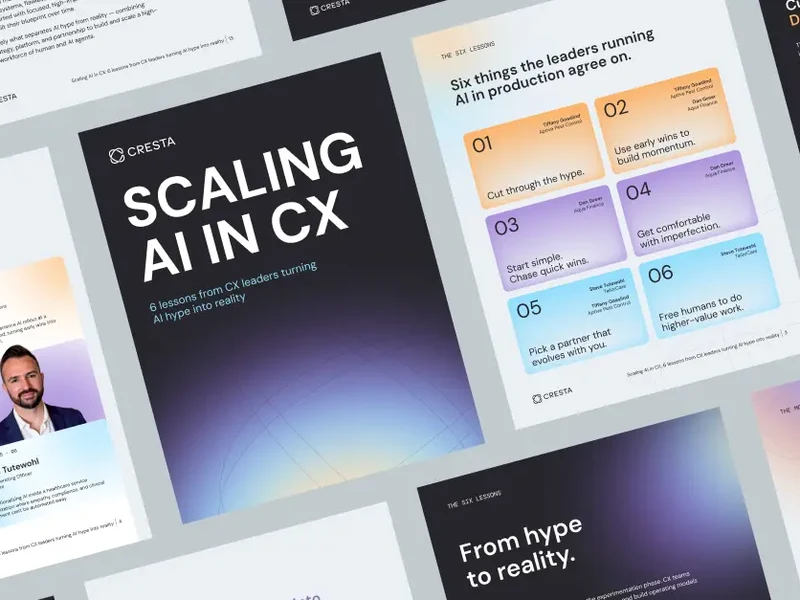
Lessons from CX leaders who've taken AI to production
The benefits of AI in contact centers that show up in the numbers
The benefits of Customer Experience AI that survive scrutiny are improvements in customer-confirmed outcomes. Containment can rise on a dashboard while repeat contacts and dissatisfied callbacks climb behind it. Real-time guidance, automated quality management (QM) coverage, and end-to-end automation improve first call resolution and handle time while lowering QM cost.
Resolution and handle time gains
Operating metrics prove whether the deployment worked. Real-time guidance and end-to-end automation affect first call resolution and handle time first. Cresta Agentic Assist provides real-time guidance and knowledge to human agents during live conversations, giving them the right policy or next step before the customer loses patience.
A unified deployment can improve several operating metrics at once. After deploying Cresta, Brinks Home achieved a 30-point Net Promoter Score (NPS) increase and a 73% reduction in transfer rate, from 30% down to 8%. Average handle time fell 8% and QM costs fell 50%. Annual cost savings reached hundreds of thousands of dollars.
QM coverage beyond the manual sample
Automated scoring extends quality management from a thin manual sample to every interaction. Manual review consumes supervisor time and still leaves performance patterns hidden, especially when the conversations that drive churn are not the ones a supervisor pulls. Cresta Quality Management scores conversations against defined criteria across the contact center.
Every-interaction scoring turns coaching from a guess into a defensible conversation about specific behaviors. After deploying Cresta, CVS Health moved from scoring 5% of calls to 100% with AI. The team added predictive CSAT on 100% of calls and cut time to insight from weeks to immediate.
Readiness for agentic AI
Unified conversation data pays off again as agentic AI matures. Memory-rich agents need access to customer history, policies, prior outcomes, and live conversation context. Gartner predicts that agentic AI will resolve 80% of common customer service issues without human intervention by 2029. Contact centers that connect conversation data across channels today can hand that context to an agentic system when they scale.
How to measure and sustain contact center transformation
A weekly operating review keeps an AI program honest, and it only needs three numbers. Resolution rate confirms customers actually got their problem solved rather than deflected. QM coverage percentage shows whether coaching rests on every interaction or a thin sample. Coaching cycle time measures how fast an insight reaches the agent, because feedback delivered days later arrives too abstract to change behavior.
Each metric should end in a decision. When resolution dips on a topic, pull the conversations behind it and check whether the gap is knowledge, process, or automation scope. Cresta's predictive CSAT scores every conversation from the words used, so teams see satisfaction risk without waiting weeks for survey returns. Cresta Insights connects each metric movement to the behaviors behind it, and managers turn the gap into that week's coaching plan through Coach.
Treating full automation as the end state damages outcomes. PwC's 2025 Customer Experience Survey found that 86% of consumers say human interaction is moderately or very important in their brand experience. The same survey found that 29% have stopped using or buying from a brand after a poor customer experience. High-emotion and escalated conversations still need a human agent present, while Agentic Assist handles context retrieval and transfer summaries in the background.
Turn contact center AI change into an operating habit
Dashboards and pilots multiply, yet performance drifts when analysis never reaches the next conversation. Contact center AI pays off when an insight becomes a coaching theme, a real-time prompt, and a measurable change in outcome on the same data layer. Conversation Intelligence analyzes every interaction and Agentic Assist brings guidance into live conversations. AI Agent automates conversations when the data, integrations, and guardrails are ready.
Cresta runs that loop on one platform, with human-centric agentic AI that turns strategic insights into better business outcomes. Browse the Cresta resource library for guides on automated quality management and outcome-tied coaching, or request a demo to see the platform in practice.
.jpg)


