
How to Automate Quality Monitoring in Contact Centers


• Automated quality monitoring solves a structural problem that manual sampling never could. Evaluating 2-5% of conversations leaves most performance gaps, compliance violations, and coaching opportunities invisible until they surface as larger operational problems.
• Real-time and post-call monitoring solve different problems. Real-time enables supervisor intervention and compliance prevention before damage is done. Post-call identifies patterns across large datasets that would stay buried in sampled approaches. The strongest programs use both.
• Scoring 100% of conversations only creates value when those scores flow directly into coaching actions. The guide covers how to build a closed-loop system where quality insights connect to specific behaviors, targeted coaching plans, and real-time guidance on the next call.
• Most organizations maintain human oversight alongside automation for calibration, complex judgment calls, and developmental coaching. AI handles coverage at scale while humans focus on the edge cases and agent development that data alone can't address.
Automated quality monitoring uses AI to score 100% of conversations against defined criteria, connect agent behaviors to business outcomes, and feed insights directly into coaching and real-time guidance. For organizations still relying on manual sampling, the gap between what they know about their operation and what's actually happening grows with every unreviewed interaction.
This guide covers how automated quality monitoring works, how to design scorecards that connect behaviors to outcomes, and how to measure return on investment.
How automated quality monitoring works
Automated quality monitoring operates through a five-stage pipeline that transforms raw conversation data into actionable intelligence. Successful implementations require integration across your phone system, CRM, workforce management, and historical QM data into a unified foundation.
Speech-to-text transcription
Modern systems use custom speech recognition models trained on contact center audio. The best platforms achieve 92% or higher transcription accuracy through domain-specific fine-tuning on customer audio and business vocabulary, not generic speech-to-text engines. This matters because contact center conversations include industry jargon, product names, and conversational patterns that generic models handle poorly.
Cresta starts by selecting the best-performing speech-to-text model for a given use case, then fine-tunes it on domain-specific customer data to improve accuracy on the industry terminology, speech patterns, and telephony audio conditions that generic models handle poorly. Even small transcription errors compound across downstream AI tasks like sentiment detection, intent classification, and compliance flagging.
Conversation analytics
Natural language processing (NLP) examines meaning rather than keywords. The systems analyze tone and sentiment, detecting customer frustration before it's verbally expressed. Advanced platforms go beyond simple sentiment scoring to detect specific behaviors and intents that matter for your business. This requires purpose-built AI for contact center conversations, not generic LLM wrappers adapted after the fact.
Behavior detection
Systems identify specific agent behaviors that impact outcomes, including empathy demonstration, active listening patterns, objection handling, script adherence, and product knowledge accuracy. For example, "overcoming objections" means understanding customer hesitation, acknowledging concerns, providing value statements, and confirming resolution. The key is detecting these behaviors through semantic understanding, not just keyword matching.
Outcome detection
This is where automated QM separates from basic analytics. Leading platforms connect behaviors to business results through outcome inference models that can classify whether a sale was made, whether the conversation was resolved, what the customer satisfaction score was, and whether a customer churned or was retained.
This outcome inference capability is technically challenging, and most vendors cannot implement it. Cresta's AI models infer business outcomes directly from conversation transcripts, a primary technical differentiator that sets platforms that track actual results apart from those that track keywords and sentiment. Organizations evaluating automated QM should ask vendors specifically how they connect conversation content to business outcomes.
Auto-scoring
Systems score 100% of conversations using consistent criteria across compliance, quality, outcomes, and skills. This eliminates the coverage limitations and evaluator bias inherent in manual QM.
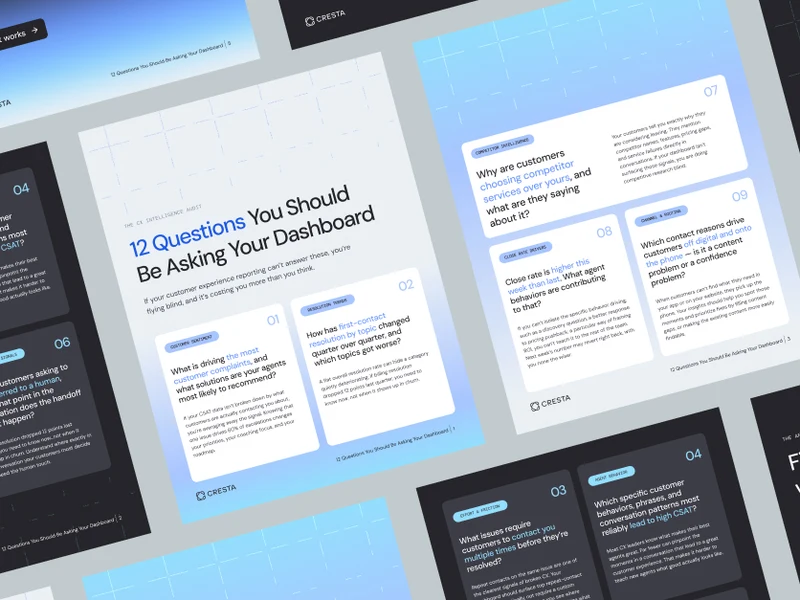
Test what your monitoring data explains before automating with these 12 questions
Designing scorecards for automated evaluation
Contact center scorecards should prioritize depth over breadth. Effective scorecards keep compliance criteria intact while replacing subjective evaluations that don't correlate with outcomes. Instead of scoring agents on vague measures like "professionalism" or "tone," automated QM can evaluate specific behaviors like active listening, objection handling, and next-step confirmation, and then test whether those behaviors actually drive resolution, satisfaction, and conversion.
The most important shift in automated QM is moving from scorecards based on executive intuition to scorecards based on data. Traditional QM asks, "What behaviors do we think good agents should demonstrate?" Outcome-driven QM asks, "What behaviors does the data show actually correlate with sales, resolution, and customer satisfaction?"
This shift changes everything. When you can see which behaviors correlate with which outcomes across 100% of conversations, you stop guessing about what matters. The scorecard reflects what the data proves actually drives results.
Behavior-based standards
Behavior-based standards focus on specific actions agents can directly control: opening strength and greeting quality, active listening demonstrated through reflection and confirmation, objection-handling approaches, and value communication techniques.
Outcome-based scoring
Outcome-based scoring measures business results: first call resolution (FCR) rates, customer satisfaction (CSAT) indicators, conversion success for sales interactions, and compliance adherence verification.
Traditional CSAT measurement has several compounding problems. Surveys generate 1-5% response rates, leaving the vast majority of interactions unmeasured. Results arrive days or weeks later, too late to intervene on the issues they surface. Leadership makes coaching and process decisions based on a tiny, self-selecting sample while dissatisfied customers churn without ever filling out a form.
Weighting and calibration
The weighting step represents the most critical design decision. Organizations must identify core criteria and weight each criterion by demonstrated revenue or customer experience impact using historical performance data. They should correlate specific agent behaviors with outcome metrics to validate the relationships and establish quarterly review cycles for weight adjustment.
When automated systems evaluate interactions, calibration ensures fair scoring. The workflow includes establishing baseline human scoring, training AI models on validated samples, comparing AI versus human scores, adjusting thresholds based on variance analysis, and implementing ongoing validation cycles.
Real-time versus post-call automation
Real-time monitoring provides immediate evaluation during active customer interactions. The approach monitors quality metrics as conversations unfold and can alert supervisors when intervention may be needed, providing objective and consistent scoring on every contact.
Real-time monitoring enables immediate intervention during difficult conversations, live agent support, compliance violation prevention, and customer escalation avoidance. This real-time capability is a genuine differentiator when evaluating platforms. Even technologically advanced vendors often struggle with firing the right guidance at the right moment or tracking anomalies as they happen.
Cresta's Agent Operations Center provides human-in-the-loop supervision for both human and AI agents, with the ability to monitor, guide, and intervene across hundreds of simultaneous conversations. This visibility and control distinguishes platforms built for real-time operations from those that retrofit real-time capabilities onto batch architectures.
Post-call automation focuses on structured analysis after interactions are complete. Post-call systems identify patterns across large datasets that would remain invisible in sampled approaches.
Organizations benefit from implementing both methodologies. Real-time monitoring directly impacts key metrics like FCR and CSAT by preventing negative customer outcomes before they occur. Post-call automation provides analysis across 100% of interactions to identify patterns, trends, and issues that inform training programs and process improvement.
Compliance monitoring and security
Automated compliance monitoring has become a business imperative because regulatory enforcement has intensified substantially. Contact centers face multiple overlapping frameworks:
- PCI-DSS mandates encryption and access controls when handling payment card data, and lists DTMF masking as one possible method for protecting PAN in verbal or telephone environments
- HIPAA requires access controls, encryption, and workforce training for PHI recordings
- GDPR establishes European Union requirements including explicit consent before recording, clear information about data collection purposes, defined retention periods, and data subject rights
- TCPA and state recording laws create a patchwork of requirements across US jurisdictions, with two-party consent states requiring all parties to consent before recording
Technical security should follow ISO 27001 and SOC 2 Type II standards, including access controls, encryption, audit logging, and incident management. Organizations must define specific retention periods for each processing purpose, implement automated deletion when periods expire, and document retention schedules with legal and business justification.
Hybrid human-AI quality management
Despite automation capabilities, successful implementations maintain human oversight through structured processes. AI automation should handle routine compliance checks, sentiment analysis across interactions, pattern recognition for common issues, and initial scoring of all interactions. Human review remains essential for complex situations requiring contextual judgment, edge cases where AI confidence scores are low, calibration validation, and training program development.
This hybrid approach becomes especially important as organizations deploy AI agents alongside human agents. AI agents behave non-deterministically like humans, with natural variation in their responses. This means they require the same oversight tools that human agents do.
Cresta provides a unified platform across three pillars: Analyze (Conversation Intelligence), Augment (Agent Assist), and Automate (AI Agent). The same QM frameworks, behavioral detection, and outcome correlation that work for human agents apply directly to AI agents. This matters because vendors who built automation-first lack the years of quality management expertise that effective AI oversight requires.
Omnichannel quality monitoring
Modern automated quality monitoring operates on an integrated cloud infrastructure that consolidates customer interactions across voice, chat, email, messaging, and social media into a single platform.
Voice monitoring uses speech analytics to analyze 100% of calls through real-time transcription, sentiment detection, hold time tracking, and compliance phrase identification. Digital channel monitoring employs text analytics to examine response quality, compliance adherence, and resolution effectiveness. Chat requires evaluation of response time metrics, grammar quality, and brand voice consistency. Email monitoring demands response time SLA tracking and complete issue resolution assessment.
Maintaining omnichannel consistency requires unified evaluation frameworks with deliberate calibration. Organizations must ensure consistent standards across all channels while conducting calibration sessions both within each channel and across channels.
Connecting quality insights to agent development
Automated quality management creates a pipeline where quality insights directly become coaching actions. Targeted coaching identification uses sentiment-based targeting to identify agents with higher rates of negative sentiment interactions, procedural adherence monitoring to assess adherence to key internal procedures, and behavioral pattern analysis tracking specific actions like troubleshooting approaches.
The most effective platforms create closed-loop systems connecting quality management directly to coaching and real-time agent guidance. Cresta Coach translates QM insights to coaching actions by making AI-powered recommendations on who to coach and what specific behaviors to focus on, supported by conversation excerpts and outcome correlations. Real-time reinforcement occurs during live interactions through Cresta Agent Assist, ensuring behaviors identified in QM and targeted in coaching sessions receive prompting during actual customer conversations.
Research firm Forrester noted in their Q2 2025 Wave evaluation of conversation intelligence that "Enterprises succeeding with real-time guidance are likely leveraging Cresta; few vendors come close to a competitive feature set here."
Related: The best examples of call center coaching
From punitive QM to collaborative coaching
The transformation from punitive quality management to collaborative coaching represents one of the most significant cultural shifts enabled by automation. When you see 100% of an agent's conversations rather than a random sample, coaching becomes fair and specific. Instead of feedback based on a single randomly reviewed call, managers can identify patterns: "This agent is 20% behind top performers on confirming next steps before ending calls. There were eight opportunities this week, and he missed all of them. Here are those specific conversations." That feedback is defensible and actionable. The agent knows their evaluation reflects their actual performance, not luck of the draw on which calls got reviewed.
The stakes are high: contact center turnover runs 30-45% annually, with replacement costs averaging $10,000-$21,000 per agent according to Cresta's 2024 State of the Agent Report. Unfair, sample-based coaching accelerates this churn.
This is how Holiday Inn Club Vacations transformed their coaching culture. With visibility into all conversations, they increased coached conversations by 7% while agent satisfaction (ESAT) jumped from 47% to 70%. The downstream impact on retention was dramatic: attrition dropped from 120% to 60% annually.
Measuring return on investment
Contact center leaders should implement measurement frameworks that capture the full economic impact of automated quality monitoring. The challenge is that QM improvements ripple across multiple operational areas, so tracking ROI requires looking beyond just QM labor savings.
Start with efficiency measures like QM staff hours per evaluation and percentage of interactions evaluated. These capture the direct productivity gains from automation. But the more meaningful metrics connect QM improvements to business outcomes: quality score improvements, first-call resolution rates, and customer satisfaction trends. The question isn't just "how much QM labor did we save?" but "how did better QM coverage change agent performance and customer outcomes?"
This is where the case for automation becomes clearest. Brinks Home, one of North America's largest home security companies serving over 1 million customers, achieved a 50% reduction in QM costs while simultaneously moving from sampling to 100% coverage. But the downstream impact told the bigger story: a 30-point increase in NPS, 73% reduction in transfer rate, and 8% reduction in AHT. The QM efficiency gains funded themselves quickly, and customer experience improvements drove ongoing business value.
Choosing an automated quality monitoring platform
For organizations evaluating automated QM platforms, the key questions are whether the vendor can actually infer business outcomes from conversation content, whether real-time capabilities are native or bolted on, and whether the platform connects insights to coaching and agent guidance or treats QM as an isolated function.
Visit our resource library to explore quality management approaches and implementation guides, or request a demo to see how automated quality monitoring and closed-loop coaching work in practice.
.jpg)


