Call Center AI Analytics: Top QA and Analytics Tools for 2026


- Every conversation, not a sample: Modern AI analytics reads all of your customer conversations instead of a small slice, so contact center analytics finally reflects reality.
- Insight should drive action: The strongest platforms connect analysis to real-time guidance and coaching, so what you learn changes what agents do next.
- Comprehension beats keywords: Speech analytics has moved from spotting keywords to understanding behavior and intent in context.
- Automated QA tools scale quality: AI can score interactions consistently, which makes quality reviews defensible instead of anecdotal.
- Fit decides the winner: The right tool depends on your stack, your compliance needs, and whether you want analytics alone or a unified platform that includes conversation intelligence.
Most quality programs still review only a small sample of calls. That means leaders are making big decisions based on a fraction of what happens on the floor. The conversations that shape customer loyalty, revenue, and compliance mostly go unseen.
Call center AI analytics changes that. It uses AI to read every conversation, not just a handful, and to explain what is happening and why.
If you lead a contact center, you are probably asking a few sharp questions. Which platform analyzes every conversation? Which one turns that insight into action agents can use? And which one fits your existing stack and your compliance needs?
This guide answers those questions. It covers the leading call center AI analytics and automated quality assurance platforms for 2026, along with the criteria you need to evaluate them.
One idea sits underneath the whole list. Analytics should be the "Analyze" step that feeds action, not a dashboard you glance at and forget. Cresta frames it this way, and it is the lens we use to compare every tool here.
Top Call Center AI Analytics Tools for 2026 at a Glance
The table below compares the featured platforms at a high level. It focuses on who each tool fits best, its core analytics strength, whether it works during the call or after, and whether it is a unified platform or a point tool.
CCaaS means Contact Center as a Service, a cloud platform that runs your phone, chat, and routing. A point tool solves one job well. A unified platform shares one foundation across analytics, guidance, and automation.
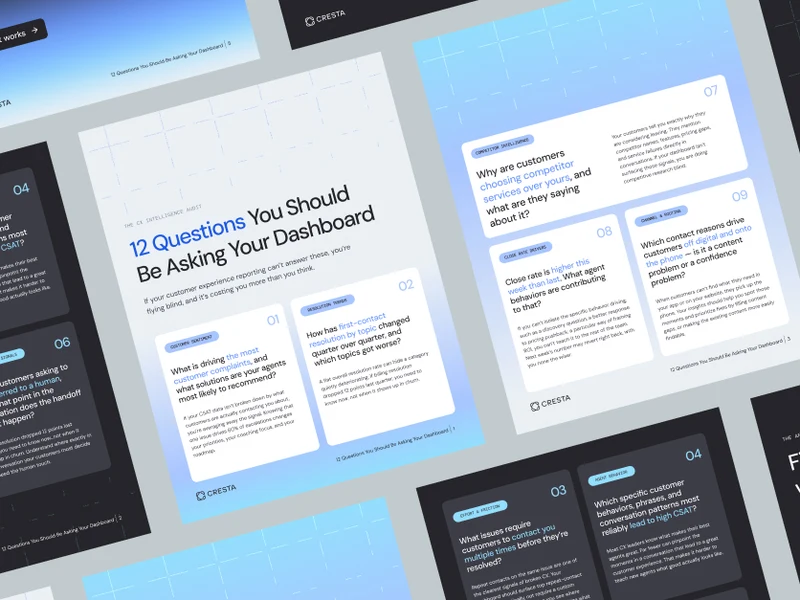
Evaluate your options with these 12 questions
What Is Call Center AI Analytics?
Call center AI analytics is software that uses AI to analyze customer conversations across voice and digital channels and surface what is happening and why. It reads calls, chats, and messages, then turns them into structured insight about intent, sentiment, and outcomes.
This differs from traditional analytics. Traditional analytics reports what already happened, such as call volume or average handle time. It tells you the score after the game is over.
It also differs from basic speech analytics. Speech analytics is technology that scans conversations for specific words or phrases. It can flag when a keyword appears, but it does not understand what the customer meant.
Two other terms matter here. Quality assurance is the practice of reviewing conversations to check whether agents met the standards you set for service, accuracy, and compliance. Conversation intelligence is AI that analyzes full conversations to explain behavior and outcomes, not just spot words.
The modern baseline is different from the old one in two ways. First, the best tools analyze every conversation rather than a sample. Second, they use behavioral recognition, which reads context and comprehension instead of matching keywords. That is how they catch the intent, emotion, and signals that a word search misses.
How AI Analytics Differs From Traditional Call Center Analytics
Traditional call center analytics summarizes past metrics and reviews only a sample of calls. It is useful for trends, but it cannot tell you why a customer was frustrated or why a sale slipped away.
AI analytics goes deeper. It interprets intent, emotion, and outcomes across every interaction, and it can act while the conversation is still live.
The biggest shift is coverage. Older methods judged the floor from a thin slice of calls. Modern contact center analytics reads all of them, which gives leaders a reliable view for quality management and daily decisions.
Speech Analytics vs Behavioral Comprehension
Keyword-based speech analytics has a hard limit. It can tell you that a word was said, but not what the customer wanted or how they felt. Two calls can use the same words and mean very different things.
Behavioral comprehension solves this. It reads the full context of a conversation to detect intent, sentiment, and the moments that matter, even when no obvious keyword appears. It relies on natural language processing, the AI field that lets software interpret human language.
This is where Cresta's behavioral recognition stands apart. Instead of matching phrases, it identifies specific customer signals and agent behaviors as they happen, and it does so using models trained on your own conversations.
What Call Center AI Analytics Does for Enterprise Teams
For enterprise teams, call center AI analytics is not one feature. It powers several jobs that used to sit in separate systems.
The three that matter most to CX leaders are quality assurance, agent coaching, and customer experience monitoring. Below is how each one works when analytics reads every conversation.
Automated Quality Assurance and Quality Management
Manual quality assurance reviews only a few calls per agent, so scores are easy to dispute and hard to trust. Automated QA tools change the math by scoring interactions against a rubric automatically.
Call center quality management becomes far more defensible this way. When the AI evaluates every conversation against the same standard, results are consistent, and a single reviewer no longer decides an agent's fate based on a lucky or unlucky sample.
Cresta Conversation Intelligence applies automated quality management across every conversation, so the score reflects the whole picture rather than a slice.
Agent Coaching and Real-Time Guidance
Analytics is most valuable when its findings reach the agent. Insight from conversations can point coaches to the exact behaviors that drive better outcomes, so coaching targets what matters instead of guesswork.
The strongest platforms go one step further and guide agents during the live conversation. This is where conversation intelligence and real-time guidance meet.
Cresta calls this the answer ownership loop. One conversation record powers quality assurance scoring, coaching, and live guidance through Agent Assist, so insight and action run on the same foundation. Cresta augments agents in the moment while the person stays in control.
Cresta Coach is a newer part of this lineup. It uses quality and outcome data from every conversation to build a personalized coaching plan for each agent, backs every recommendation with conversation evidence, and prioritizes coaching by the outcomes you care about, like sales, resolution, and CSAT. It also closes the loop by tracking whether coaching changes agent behavior over time, and it connects to real-time guidance so coaching is reinforced on live conversations.
Cresta Training Simulator is another newer addition, built for practice. Agents rehearse against simulations made from real customer conversations, powered by the same AI behind Cresta AI Agent, so the simulated customers respond and push back like real ones. Each run is graded on the same behaviors measured on live calls, supervisors can assign targeted practice that shows up in the agent's coaching plan, and new hires ramp faster while tenured agents stay current on new processes.
Customer Experience and Compliance Monitoring
Reading every conversation also gives leaders a clear view of customer experience. Customer experience monitoring tracks sentiment, recurring issues, and trends across all interactions, so problems surface early instead of after churn.
For regulated industries, this coverage matters even more. When AI checks every conversation for compliance signals, teams in financial services, insurance, healthcare, and telecom can prove they are meeting requirements rather than hoping a sampled call was representative.
The Best Call Center AI Analytics Tools for 2026
We grouped the platforms below by what they do best, not by a single ranking. Each fits a different starting point, whether you want a broad suite, a specialist analytics tool, or a unified platform that connects analysis to action.
For each option you will find an overview, a "best for" label, a quick reference table, key capabilities, and honest considerations. Use the "best for" labels to match a tool to your situation.
Cresta: Best For Connecting Analytics to Real-Time Action
Cresta is a Customer Experience AI company. Its platform brings Conversation Intelligence, Agent Assist, and AI Agent together on one foundation, so analysis, live guidance, and automation share the same conversation layer.
Cresta grew up in the AI-native era, not as a bolt-on to an older suite. That heritage shows in how the platform is built. Models are trained on each customer's own conversations, so insight reflects how that specific business runs rather than a generic template.
For an enterprise buyer, Cresta fits when analysis of every conversation needs to feed action, not just fill a dashboard. AI Agent handles autonomous voice and digital conversations, and Cresta Opera is the no-code engine used to build, test, and deploy those AI workflows.
Its key capabilities set it apart.
- Behavioral recognition: Cresta reads intent and behavior through context and comprehension, not keyword matching, so two calls with the same words are still understood differently.
- Trained on your own conversations: Models are fine-tuned on your real interactions rather than generic data, so insight reflects how your business runs.
- Conversation Intelligence: Insights, AI Analyst for natural-language deep research on conversations, automated Quality Management, Coaching, and Automation Discovery all run across every interaction.
- The answer ownership loop: One conversation record powers quality management scoring, coaching, and live guidance at once, so insight feeds action and action feeds insight.
- Agent Assist and AI Agent: Real-time guidance, Knowledge Agent for source-backed answers, and automated summaries help live agents, while AI Agent handles the conversations neither party wants to have.
Cresta augments human agents and keeps people as the decision-makers. It also brings enterprise guardrails, testing, and governance for regulated industries.
Considerations:
- Cresta is strongest when your team intends to act on insight across guidance and coaching, not only report on it.
- If you want a passive dashboard and nothing more, you will not use the closed loop that makes the platform valuable.
NICE: Best For Large Enterprises Standardized on a Full CCaaS Suite
NICE offers a broad enterprise suite that includes analytics and quality management alongside its wider contact center platform. It is a mature, well-known option in the category.
Its heritage is the full CCaaS suite. Analytics and quality management sit inside that wider platform rather than standing alone, which is a strength for teams already invested in the ecosystem.
For an enterprise buyer, NICE fits when analytics can plug into contact center tools you already run on the same platform.
Key capabilities:
- Suite-wide analytics: Analytics and reporting are built into the broader contact center platform.
- Quality management: Quality management tools sit alongside the wider suite.
- Ecosystem fit: Capabilities are designed to work together across the NICE platform.
Considerations:
- The analytics are strongest inside the NICE ecosystem.
- If your stack lives elsewhere, weigh how well the suite fits contact center analytics software you already use.
Verint: Best For Interaction Analytics and Workforce Engagement Depth
Verint is known for interaction analytics and workforce engagement management, with real strength in compliance-heavy environments. Interaction analytics is the analysis of customer conversations across channels to surface trends and risks.
Its heritage is depth in analytics and workforce engagement. That focus makes it a familiar name for teams that prioritize analytics and compliance controls.
For an enterprise buyer, Verint fits when analytics depth and broad workforce engagement features are the priority.
Key capabilities:
- Interaction analytics: Analysis of conversations across channels to surface trends and risks.
- Workforce engagement management: Tools that manage and engage the agent workforce.
- Compliance strength: Capabilities suited to compliance-heavy environments.
Considerations:
- The experience is centered on the Verint platform.
- As with any suite, evaluate how its speech analytics and workforce tools fit the systems you plan to keep.
Genesys: Best For Teams Anchored on the Genesys Cloud Platform
Genesys Cloud pairs contact center operations with analytics and customer journey capabilities. It is a common choice for teams that want routing, channels, and reporting in one place.
Its heritage is contact center operations. Analytics and customer journey views sit alongside routing and channel management, which suits teams that treat the platform as their operational hub.
For an enterprise buyer, Genesys fits when your team is already anchored on Genesys Cloud and wants analytics in the same place as operations.
Key capabilities:
- Contact center operations: Routing and channel management in one platform.
- Customer journey views: Analytics that map the customer journey.
- Unified reporting: Operations and analytics reporting together.
Considerations:
- The analytics are tied to the Genesys ecosystem.
- If you are not on Genesys, factor in how its contact center analytics connect to your other tools.
CallMiner: Best For Deep Post-Interaction Conversation Analytics
CallMiner is a conversation analytics specialist focused on deep post-interaction analysis. It gives mature analytics teams a detailed way to mine finished conversations for patterns and root causes.
Its heritage is analytics depth rather than live operations. That focus makes it a strong fit for teams whose value comes from studying conversations after they end.
For an enterprise buyer, CallMiner fits when you have the analysts and processes to act on rich post-call analysis.
Key capabilities:
- Post-interaction analytics: Detailed analysis of finished conversations.
- Pattern and root-cause discovery: Tools to mine conversations for patterns and causes.
- Analyst-friendly depth: Built for teams with dedicated analytics resources.
Considerations:
- Its strength is in post-call analysis rather than real-time guidance.
- If you need conversation intelligence that guides agents during the call, confirm how CallMiner covers that or compare CallMiner alternatives built for real-time guidance
Observe.AI: Best For AI-Native QA and Post-Call Automation
Observe.AI is an AI-native platform built around automated QA and interaction intelligence. It is designed to score conversations and support coaching workflows.
Its heritage is AI-native quality assurance. The platform centers on automated QA, with post-call automation and coaching built around it.
For an enterprise buyer, Observe.AI fits when automated QA tools and post-call automation are the main goal.
Key capabilities:
- Automated QA: Automated scoring of conversations against your standards.
- Interaction intelligence: Analysis that surfaces what happened in conversations.
- Post-call automation and coaching: Workflows that act on findings after the call.
Considerations:
- Evaluate the breadth of its real-time and unified-platform capabilities against your needs.
- This matters most if you want live guidance and analytics to run on one shared layer.
How to Choose a Call Center AI Analytics Platform
There is no single best tool, only the best fit for your situation. The right choice depends on your existing stack, your compliance needs, and how much you want analytics to drive action.
Use these scenarios to guide the decision.
- You are standardized on one CCaaS vendor: A full suite from that vendor may be the simplest path, since the analytics plug into tools you already run.
- You want analysis to drive guidance and coaching: A unified Customer Experience AI platform fits best, because insight can flow straight into what agents see and how they are coached.
- You need the deepest post-interaction analysis: A specialist analytics tool may serve a mature analytics team better than a broad suite.
Be honest about the tradeoff between point tools and unified platforms. Point tools can go deep on one job, but they leave you stitching insight to action across separate systems. A unified platform closes that gap more easily because analytics, guidance, and coaching share one conversation record, which is where the closed loop becomes practical.
Evaluation Checklist and Questions to Ask Vendors
Use this checklist to compare call center analytics software on the features that matter, then bring the questions to every vendor conversation.
Must-have features to look for:
- Analyzes every conversation: The tool reads all interactions across voice and digital, not a sample.
- Behavioral comprehension: It understands intent and context, not just keywords.
- Automated quality management: It scores interactions consistently against your rubric.
- Coaching insight: It points coaches to the behaviors that change outcomes.
- Real-time guidance: It can guide agents during live conversations, not only after.
- Integrations: It connects to your telephony, CRM, and knowledge systems.
- Enterprise guardrails: It offers testing, oversight, and governance for regulated work.
Questions to ask each vendor:
- Ask: Do you analyze every conversation, or a sample?
- Ask: Are your models trained on our own conversations, or on generic data?
- Ask: Does insight from analytics flow into live agent guidance and coaching, or stop at a dashboard?
- Ask: How does automated quality management handle appeals, calibration, and audit?
- Ask: What guardrails and oversight cover customer experience monitoring in regulated industries?
Conclusion
The strongest call center AI analytics platforms share three traits. They analyze every conversation, they understand behavior in context, and they connect insight to action.
There is no universal winner. If you are standardized on one CCaaS vendor, a full suite may fit best. If you want the deepest post-interaction analysis, a specialist tool may serve you well.
If your goal is to turn analysis of every conversation into live guidance and coaching, a unified Customer Experience AI platform like Cresta is built for that closed loop. Match the tool to your scenario, and the decision gets much clearer.
Get Started With Cresta
See how Cresta analyzes every conversation and turns that insight into real-time guidance and coaching that augments your agents. Learn more and request a demo.
.jpg)


