
At this point, saying AI agents are easy to demo but hard to get right in production is the "sky is blue" of truisms about AI deployment. Next thing you know, we'll be quoting the "90% of AI projects fail" stat.
But it keeps coming up for a reason.
If you believe the hype, a good agent is seemingly only a prompt away. That’s the promise behind many of the natural-language builders flooding the market.
But what about when the rubber hits the road, and it’s a customer on the other end of the line with a real, complex problem?
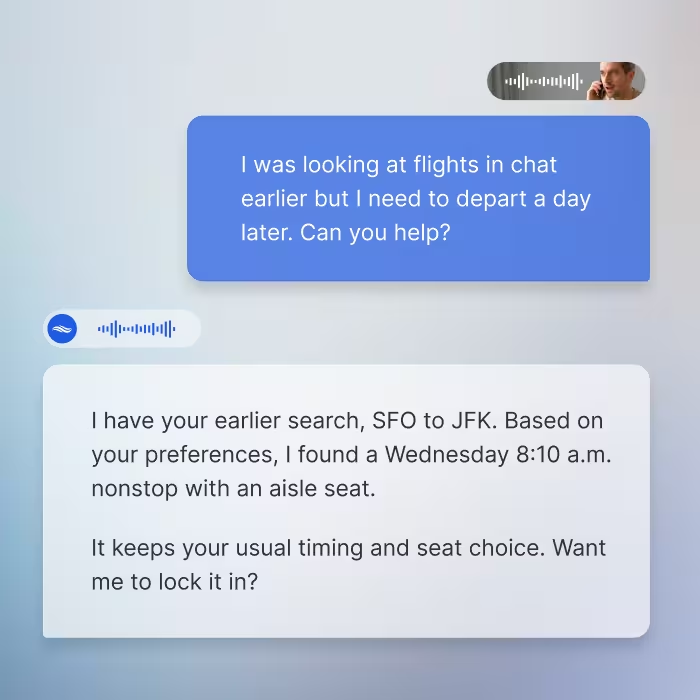
Imagine: their flight was canceled and they need to rebook. The situation seems straightforward enough until they mention a $200 travel credit from their last trip. They follow that with questions about whether flying a day earlier would be cheaper and if a second bag is included. Getting it “mostly right” here could mean a lost credit, a surprise fee at the gate, or a seat that was never actually held.
This isn’t a stress test. It’s a normal day in production. When our teams build agents around workflows like this, two challenges keep showing up:
- Designing the agent with enough business context and the right patterns from the start, so it doesn’t become brittle as the workflow gets more complex.
- Moving quickly once testing and production traffic reveal what the design missed: finding the gaps, fixing them, and feeding those learnings back into the AI agent.
That is why we’re launching Cresta Conductor, a developer-native environment for building, testing, and improving AI agents on the Cresta platform.
Conductor gives engineers and technical teams a natural-language interface for the agent development workflow: blueprinting, implementation, testing, deployment, and post-launch refinements. Developers describe what they want to build in plain language and Conductor helps them turn real business context and production signals into better agent design, faster implementation, and ongoing optimization.
From Scattered Context to a Grounded Agent Design
Great agent design depends on deep business context and understanding. What does “good” look like for this particular business? That answer comes from the operating context of the business itself: knowledge bases, SOPs, workflow documents, API requirements, escalation rules, and millions of real customer conversations.
Cresta has spent years building conversational intelligence from that complexity: understanding customer intent, agent behavior, resolution paths, workflow friction, and what good outcomes actually look like in production. Cresta Conductor brings that intelligence directly into the agent development workflow.
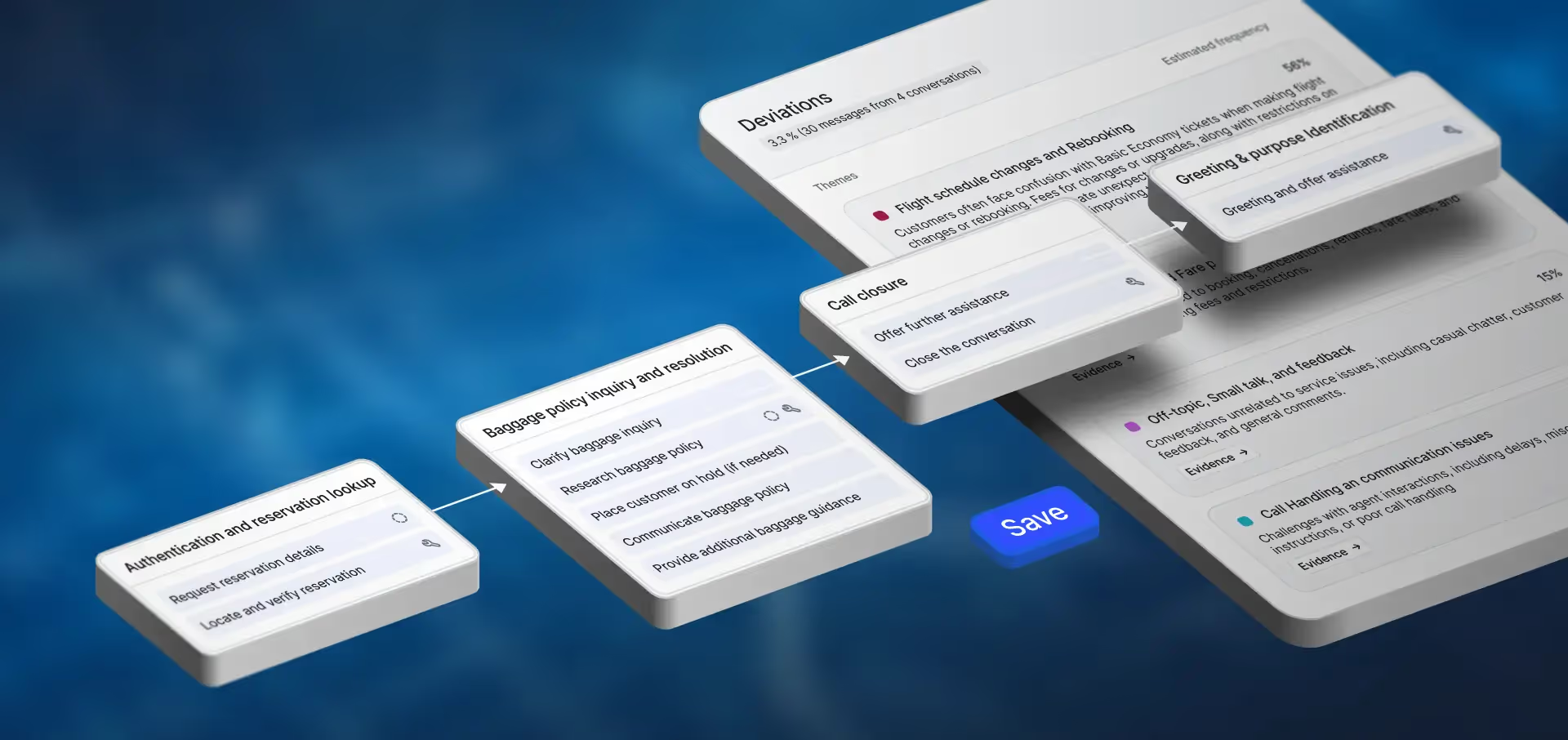
Instead of starting from a blank prompt or asking teams to manually piece together context, Conductor uses Cresta’s platform capabilities as tools, including conversation insights, topic discovery, knowledge, automation flows, AI feedback, and accumulated best practices from past enterprise deployments. Each of these become critical signals that Conductor uses to guide the agent design process.
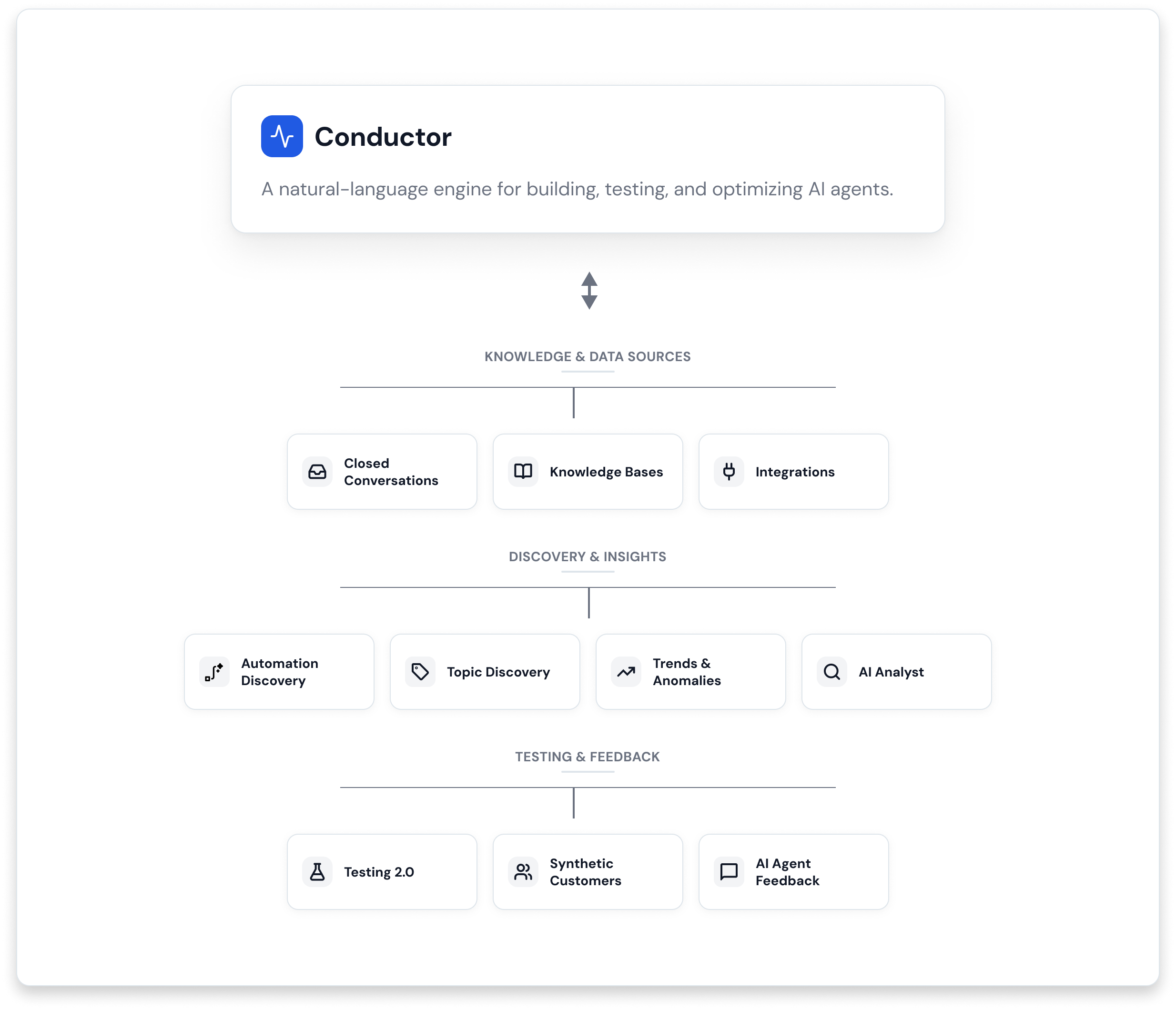
From there, Conductor asks targeted questions to further fill in the gaps: scope boundaries, escalation paths, success criteria, audience, tone, and the points in the workflow where deterministic behavior is required. Unlike solutions that move directly from a natural-language description to a generated agent, Conductor first turns that context into a grounded build plan.
The output is a clear, reviewable blueprint for the agent before anything ships. It defines the agent’s goals, scope, conversation flows, test cases, and knowledge references, which developers can refine.
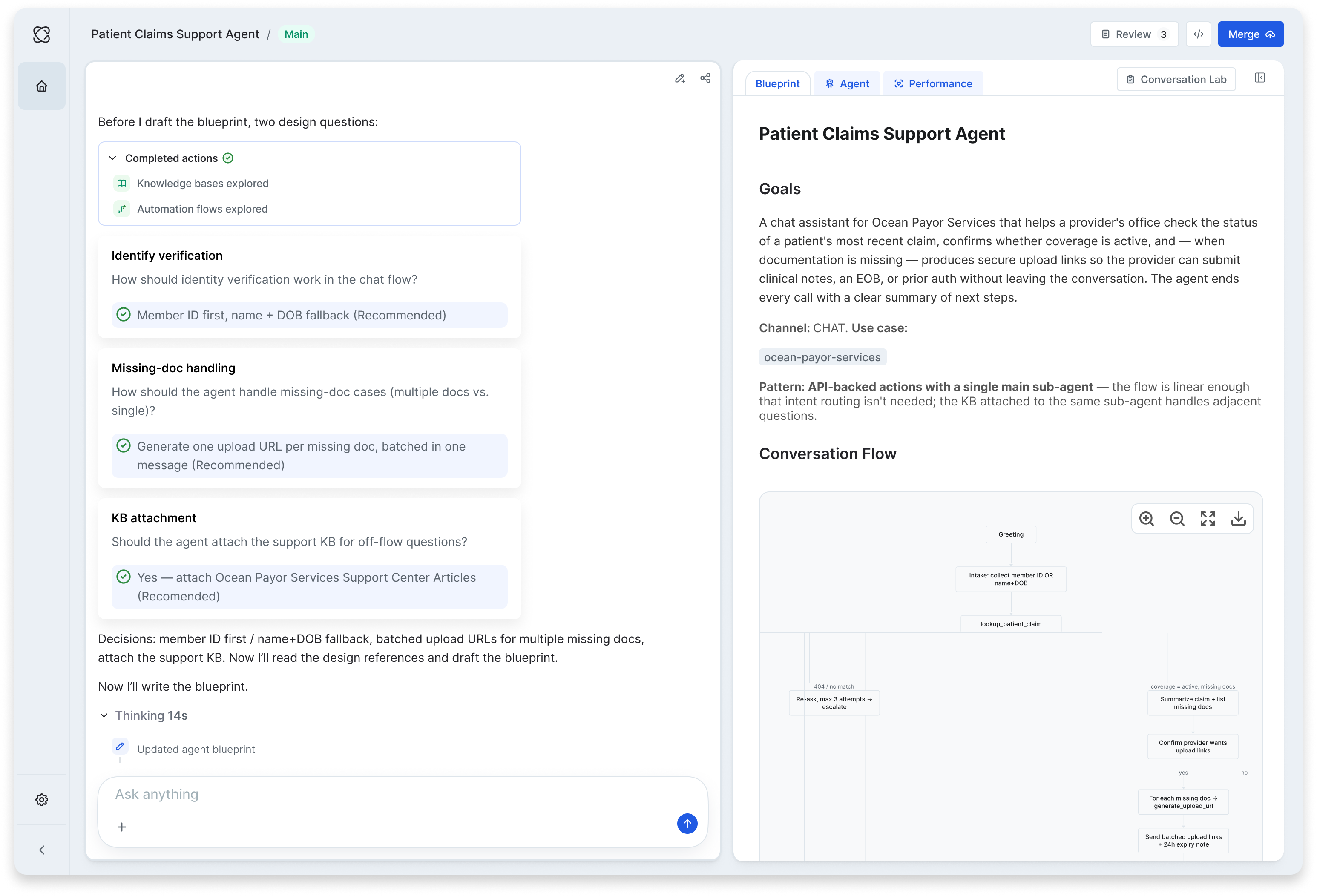
That degree of grounding is the difference between an AI agent that is demo-ready and one that is reliable in production. Without it, even a capable model can produce behavior that appears plausible, but has no actual basis in how a specific company operates, how its customers speak, or how its systems work. Teams benefit from faster time-to-production and fewer expensive course corrections along the way.
Once approved, this blueprint becomes the foundation for what Conductor builds, tests, and optimizes against, carrying this same context throughout the agent lifecycle.
From Agent Blueprint to Production Build
In real customer conversations, some moments need flexibility, while others need to happen the same way every time, like looking up an account, applying an eligibility rule, creating a case or updating a system of record. Those parts of the experience need to be reliable and that reliability comes from code. They can’t depend only on a model's interpretation of an instruction.
That’s why Conductor treats code as a first-class part of agent development. It can generate and refine the prompts, configuration, tools, integrations, and custom code needed to make the agent work in production.
It also helps teams make one of the most important design choices in agent development: what should stay in the prompt versus what needs to be implemented as code.
Prompts are flexible, but they can make behavior harder to lock down across conversations. Code gives you control, but when taken too far, it starts to feel like an IVR that happens to call an LLM. The goal is to put each part of the experience in the layer where it works most effectively.
Conductor helps teams work through those decisions faster by bringing in our accumulated knowledge from many enterprise deployments, while keeping developers in control of the final implementation.
Test and Improve Against the Conversations that Matter
After the first version is built, the same blueprint drives testing and evaluation.
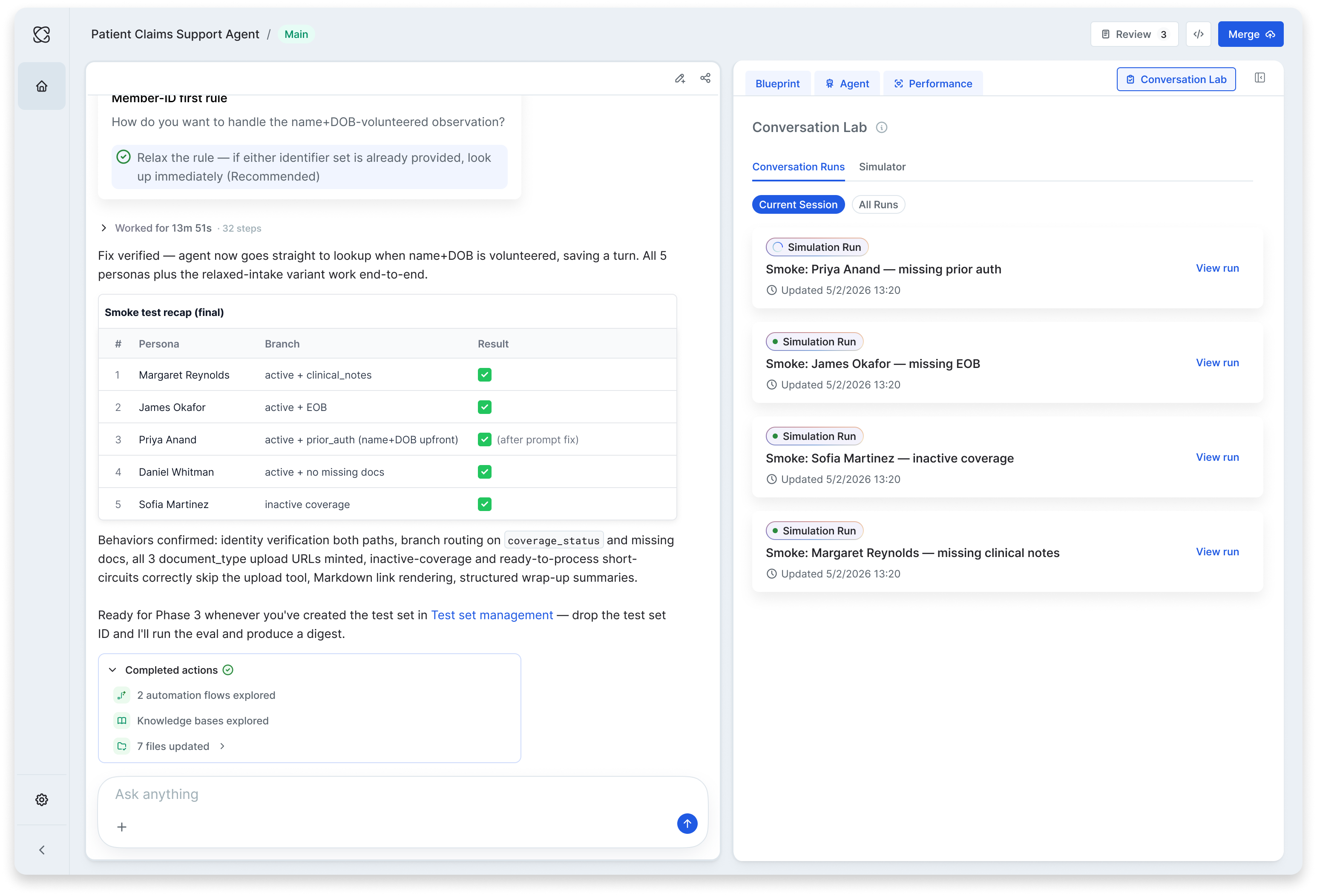
Conductor makes that iteration loop fast and grounded. It can derive business-specific test scenarios that reflect the flow, scope, tools, escalation paths, and expected behaviors the agent was designed to handle. Those scenarios are paired with human-calibrated evaluation sets powered by AI Agent Testing 2.0, so teams are improving against their own business’s definition of success, not a generic pass/fail check.
When a test case fails, Conductor helps perform root cause analysis across the agent blueprint, conversation transcript, prompt, tools, configuration, knowledge, and custom code. It then recommends the right fix and helps apply it in the right place. That might mean updating the prompt, refining the workflow, adjusting a tool definition, adding validation logic, improving a handoff, changing custom code, or turning a successful fix into a reusable pattern for future agents.
The working agent is hot reloaded, allowing developers to rerun the failed scenario immediately and confirm whether the change worked, without a heavyweight rebuild or deployment cycle.
The result is a tight engineering loop: test, fail, diagnose, fix, rerun. And after launch, production conversations keep feeding that loop. Every failed interaction, piece of feedback, tool issue, or unexpected customer path becomes a signal Conductor can analyze, trace back to root cause, and turn into the next optimization.
Built for Developers Who Want Ownership
Conductor adds a developer-native path to the Cresta platform for teams that want to work closer to the implementation and own the build lifecycle end-to-end.
In internal use, Cresta Forward Deployed Engineers have used Conductor to cut initial agent deployment timelines by roughly half. Writing custom functions, work that previously took a full week, can now be completed in one to two days. Now, teams can ship higher-quality agents with fewer people and shorter development cycles, while still maintaining the rigor that enterprise deployments demand.
See Cresta Conductor in action - sign up for our demo webinar today.