
The best agent assist software in 2027 for contact centers


- Agent assist software augments human agents with real-time answers, guidance, and summaries during live conversations
- Choose Cresta for outcome-driven guidance, NICE CXone or Genesys for CCaaS-native assist, Balto for voice-first prompts, and Observe.AI for QA-led teams
- Evaluate guidance depth, outcome linkage, QA coverage, integrations, and compliance, then prove results in a pilot
Despite the developments in AI, human agents still play a crucial role in contact centers.
Case in point: We surveyed 300 CX leaders recently as part of our Workforce Report, and we found that CX leaders are only letting AI handle 9% of their call volume.
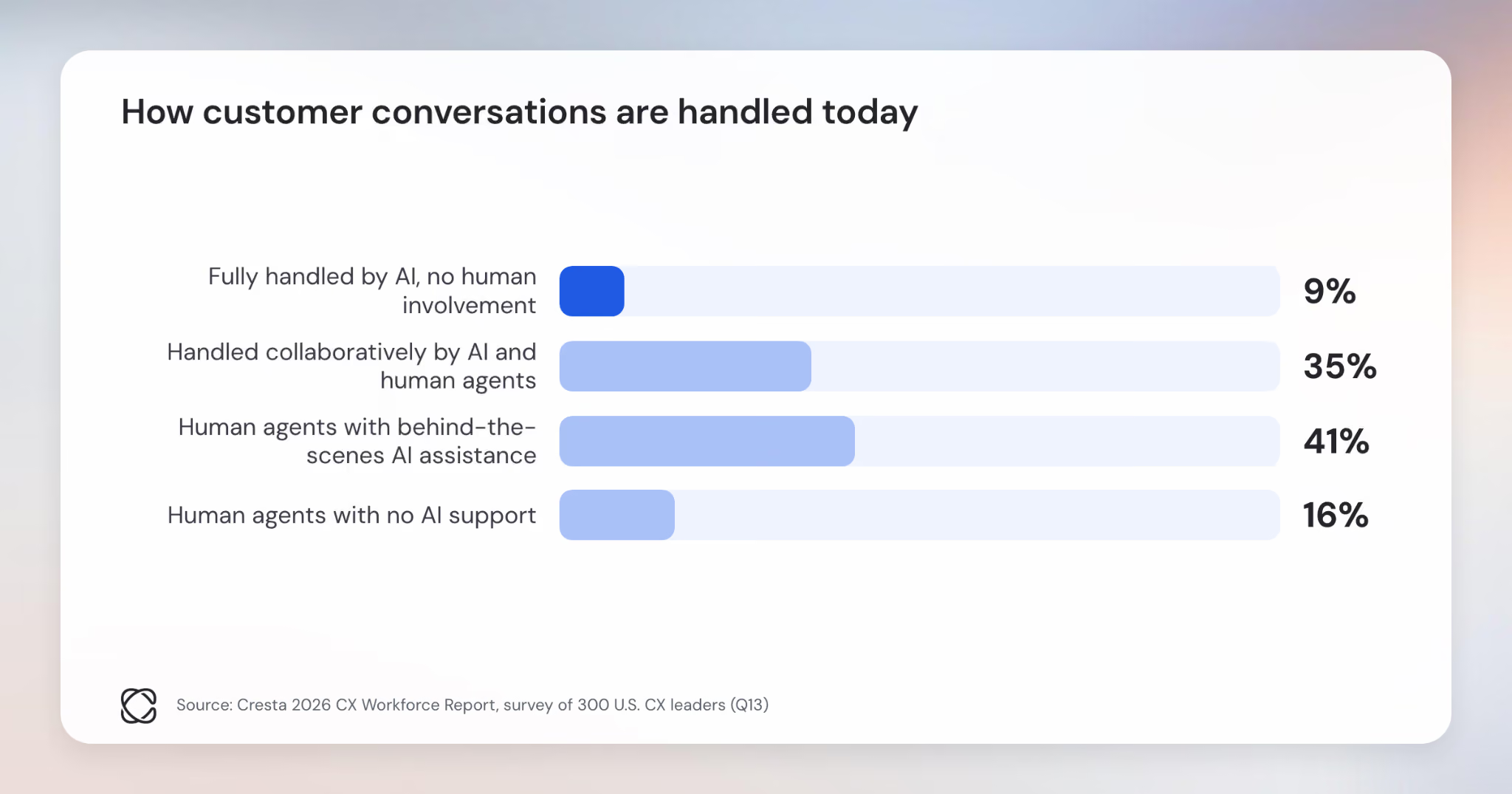
At the same time, most leaders (93%) say that the calls human agents handle are getting increasingly complex.
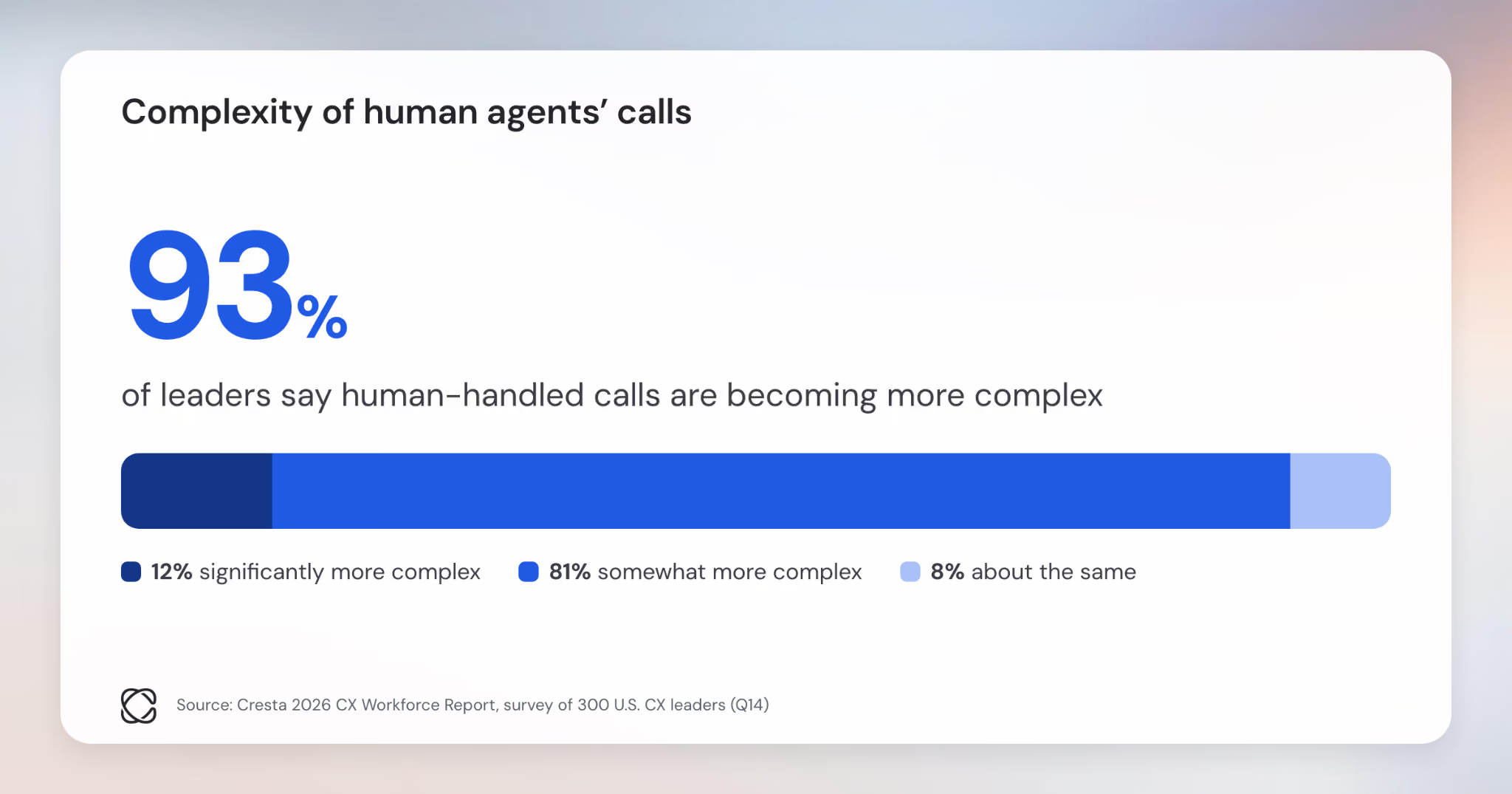
To help your human agents handle increasingly complex calls, you can equip them with agent assist software.
We’ll break down how this software works, the top solutions in the market, and how you should evaluate each option.
Note: This article was updated on 10/20/2026. The information below can change in the future.
What is agent assist software?
It's real-time AI that augments human agents during live customer conversations.
It listens to the conversation, interprets intent and context, and surfaces answers, next steps, and compliance reminders inside the tools agents already use.
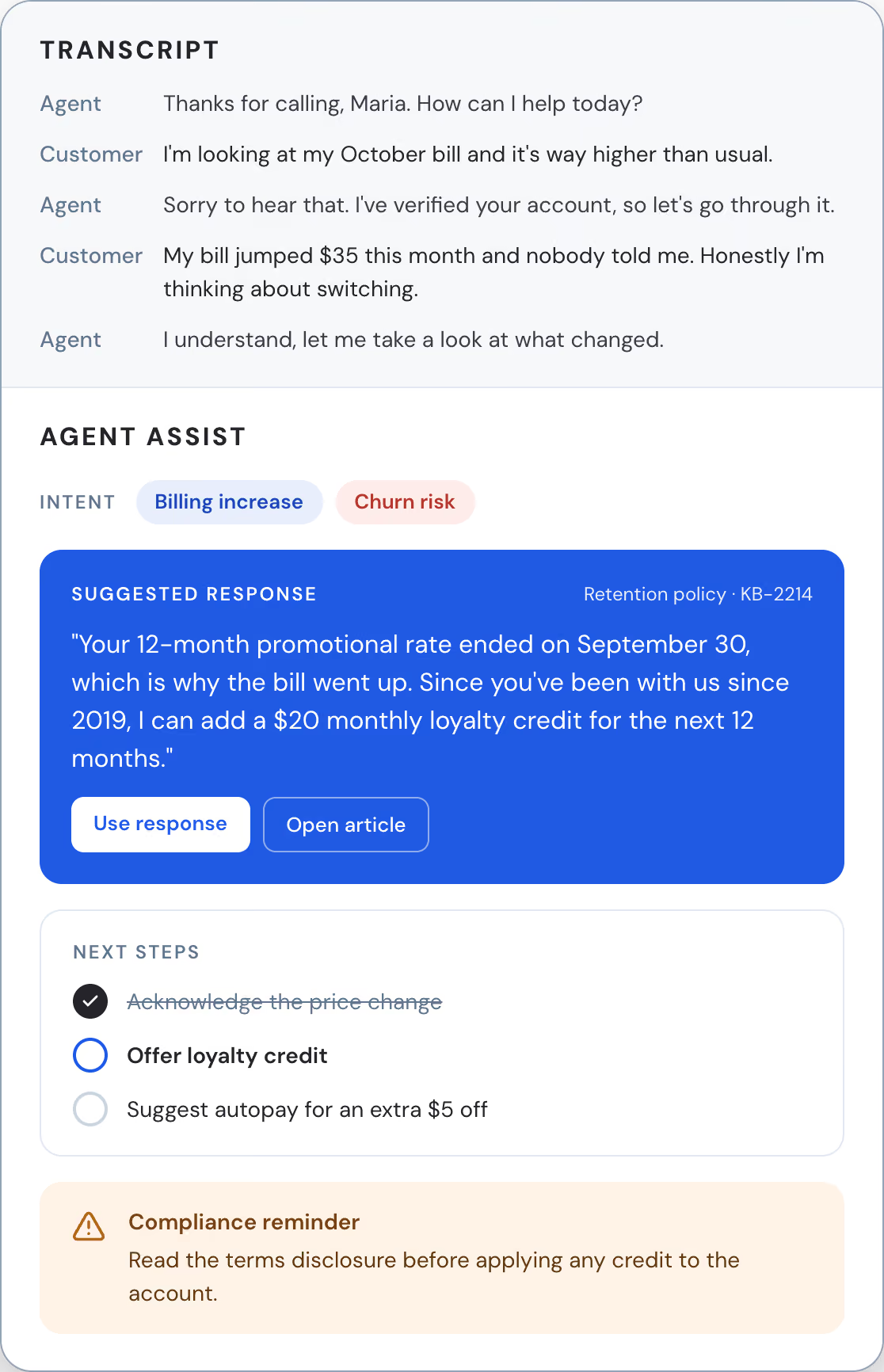
Most platforms (including the ones we’ll cover below) combine a few core capabilities:
- Real-time guidance, such as behavioral hints, next-best-action prompts, and checklists
- Knowledge surfacing, so agents don't search mid-conversation
- Live and after-call summaries that cut wrap-up work
- Supervisor tools for live monitoring, whisper coaching, and escalation
- Quality scoring that feeds coaching after the conversation
How we evaluated the best agent assist software
Our evaluation draws on third-party review sites like G2 and Gartner® Peer Insights, analyst research from Gartner and Forrester, and each vendor's product documentation. It also reflects our own conversations with customers and prospects who've used and/or evaluated these platforms.
We compared every platform against the same five criteria:
- Real-time guidance depth: whether guidance arrives during the live conversation and responds to what's happening in real-time
- Knowledge and automation: how well the platform surfaces answers and cuts after-call work
- Outcome linkage: whether guidance is tied to the behaviors that drive CSAT, resolution, and conversion
- QA and coaching coverage: whether the same data feeds quality scoring and coaching across 100% of conversations
- Deployment model: whether the platform layers onto your existing CCaaS or requires a platform change
Here's how the five platforms fared across this criteria:
Related: A guide to agent assist
The best agent assist software
Here's a closer look at each platform.
1. Cresta
Cresta is the AI operating system for CX. Its Agentic Assist offering shares one platform and conversation layer with Conversation Intelligence, AI Agent, and Deputy Agent.
You should generally use Agentic Assist when you're supporting an enterprise contact center that needs guidance tied to outcome data across every conversation.
Key agent assist features
- Real-time hints, reminders, and guided workflows are tailored to each conversation
- Knowledge Agent combines what's being said with on-screen context to surface source-backed answers
- Behavior-triggered guidance for churn signals, compliance triggers, and revenue opportunities
- Live summaries during the conversation, plus customizable after-call summaries that sync to your CRM
- Context-aware reply suggestions for chat and email
What reviewers say
G2 reviewers often praise Cresta's real-time coaching and prompts. They’ve seen it act as a catalyst for elevating their agents’ performance over time.

See how Cresta Agentic Assist can improve your agents' performance by scheduling a demo.
2. NICE CXone
NICE CXone delivers agent assist through Copilot for Agents, which runs inside the CXone agent workspace.
It's best for organizations already running NICE infrastructure that want assist without adding another vendor. The tradeoff is ecosystem commitment, since guidance runs on NICE's own AI models.
Key agent assist features
- Real-time interaction summaries as the agent works, plus an automatic summary at wrap-up
- Live customer sentiment analysis that shows the contact's current mood
- Suggested responses drawn from the knowledge base to resolve the contact's issue
- Task Assist, which pulls customer data from a CRM or other third-party apps
- Custom cards for checklists and decision trees
What reviewers say
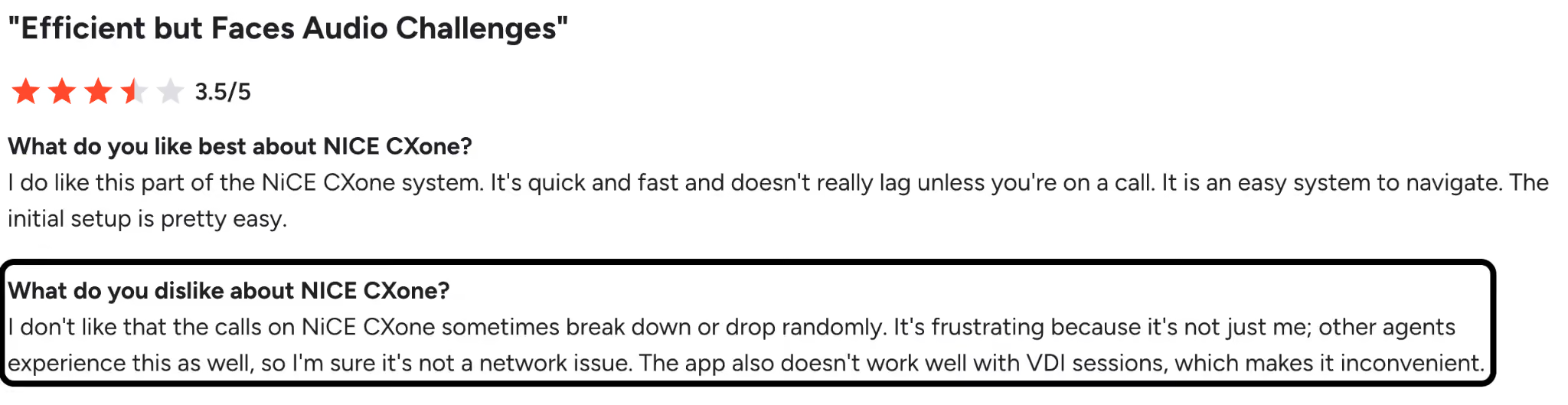
G2 reviewers like CXone's intuitive interface and easy navigation.

Common complaints extend beyond agent assist and include dropped calls, lag, and hard-to-understand reporting
Related: The top NICE CXone alternatives
3. Genesys Cloud CX
Genesys Cloud CX offers agent assist through Agent Copilot, which is built into its CCaaS platform.
It's best for organizations already on Genesys that want assist natively integrated without adding vendors. But its guidance centers on knowledge and workflow help rather than automated behavior-to-outcome correlation.
Key features
- Knowledge suggestions that highlight the exact answer within a relevant article
- AI-generated suggested answers compiled from knowledge search results
- Script and canned-response suggestions based on conversation context
- Interaction summaries with suggested wrap-up fields for reason contacted and resolution
- Agent checklists of up to seven items, triggered at the start of an interaction or by intent
- Supervisor intervention modes for voice interactions ranging from silent monitoring to direct coaching to barge-in
What reviewers say
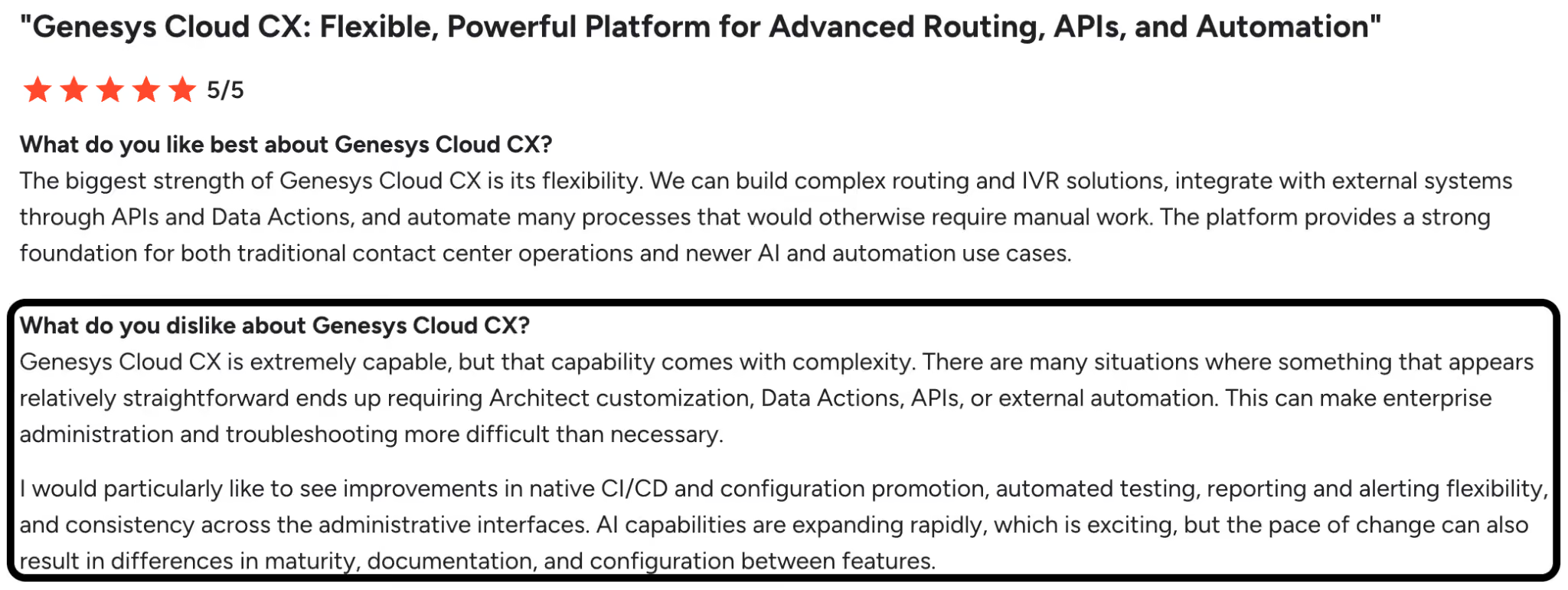
G2 reviewers like Genesys Cloud CX's ease of use and flexibility, and some Agent Copilot users credit it with putting knowledge in front of agents.

Some users however point to broader platform issues, like a steep learning curve, reporting limits, and uneven maturity across newer AI features.
Related: The top Genesys alternatives
4. Balto
Balto specializes in real-time guidance during live calls and deploys alongside existing CCaaS infrastructure. The tradeoff is scope, particularly around behavior-to-outcome analysis.
It's ultimately best for voice-first teams that want to add live prompts without replacing their stack.
Key features
- One agent workspace that combines knowledge, real-time search, customer history, and tools
- AgentGPT answers drawn from your own knowledge bases, returned with verified sources
- Automatic call summaries covering sentiment, reason, outcome, next steps, and objections, saved to the CRM
- A checklist module that helps agents follow required steps during the call
- Agent-level layout customization, including pinned modules and collapsed sections
What reviewers say
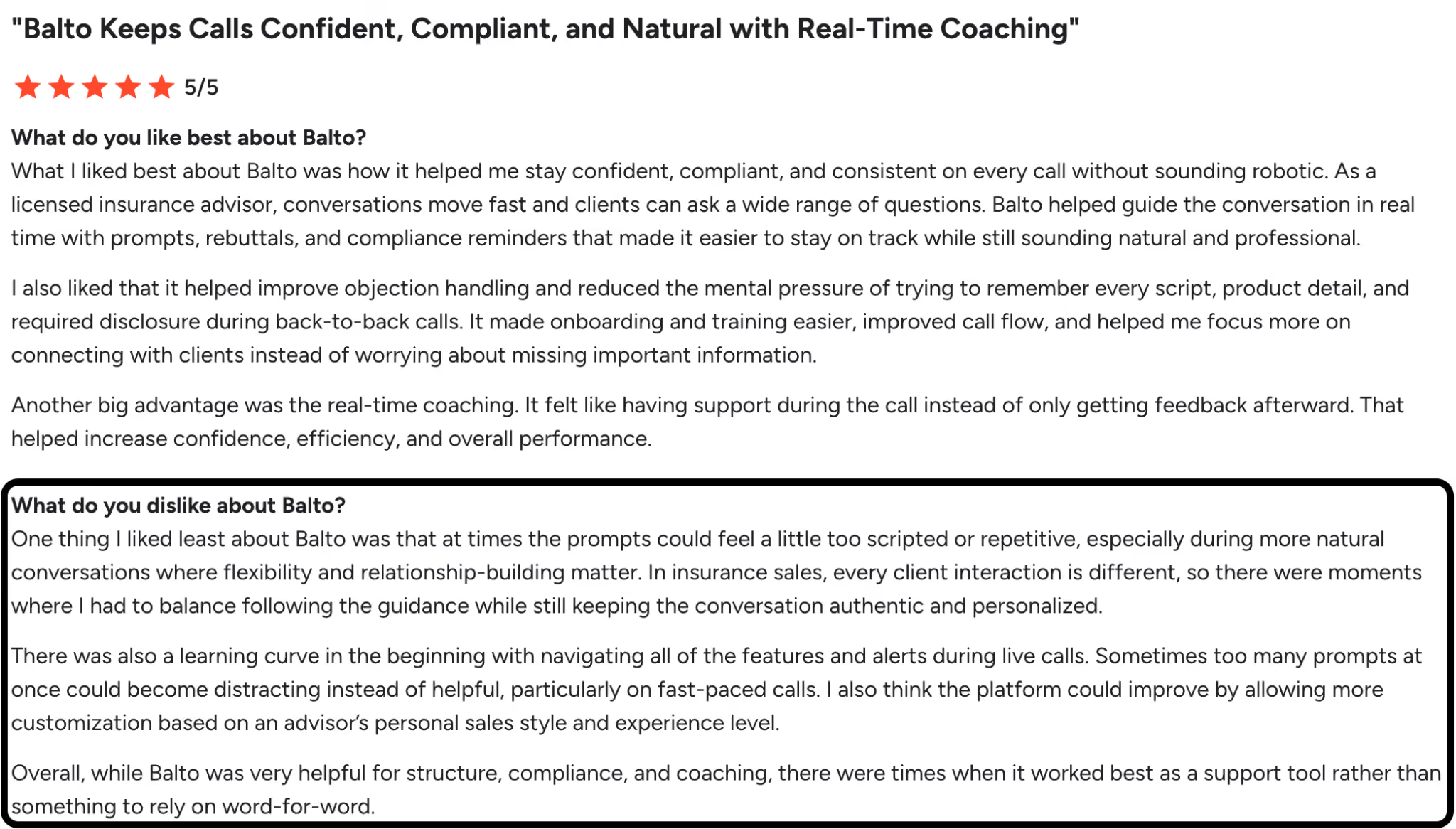
G2 reviewers praise Balto's ease of use, live call prompts, and instant call notes.
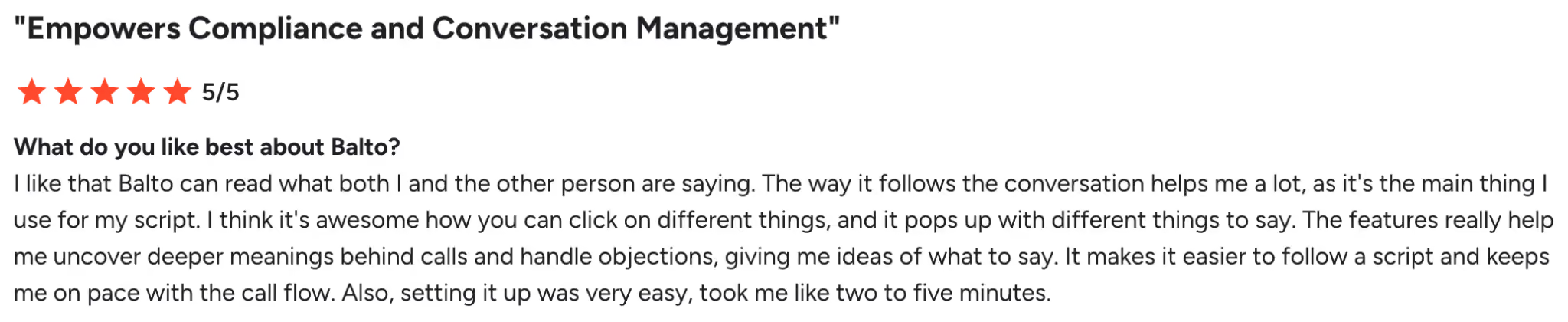
Complaints on agent assist center on prompts that can feel scripted or miss what was said.
Related: A guide to Balto alternatives
5. Observe.AI
Observe.AI pairs its QA and post-interaction analytics with Companion Agent, its real-time assist product launched over the past year 2026.
It's best for CX leaders who prioritize historical performance analysis and want assist on the same platform. That said, Companion Agent has a shorter track record than Observe.AI's post-interaction products, so it's worth testing in a pilot.
Key features
- Pre-call context, including customer history, prior interactions, and stated intent
- Step-by-step in-call guidance that surfaces knowledge and prompts required compliance actions
- Smart checklists and next best actions triggered during the conversation
- After-call summaries, extracted details, and disposition classification that update systems of record
- Guidance that teams can build and adjust with plain-English prompts
What reviewers say
G2 reviewers praise Observe.AI's ease of use, analytics, and coaching.
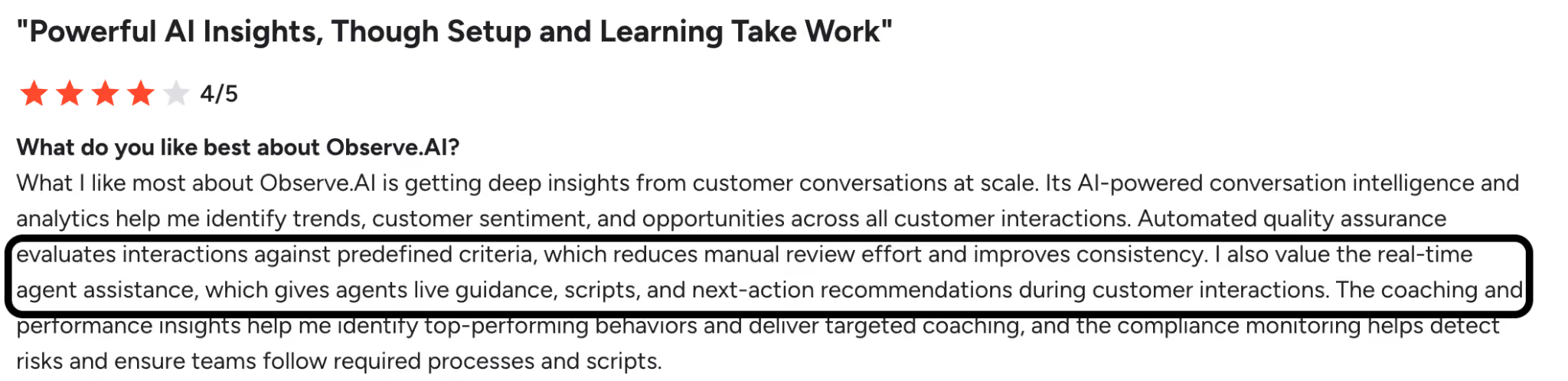
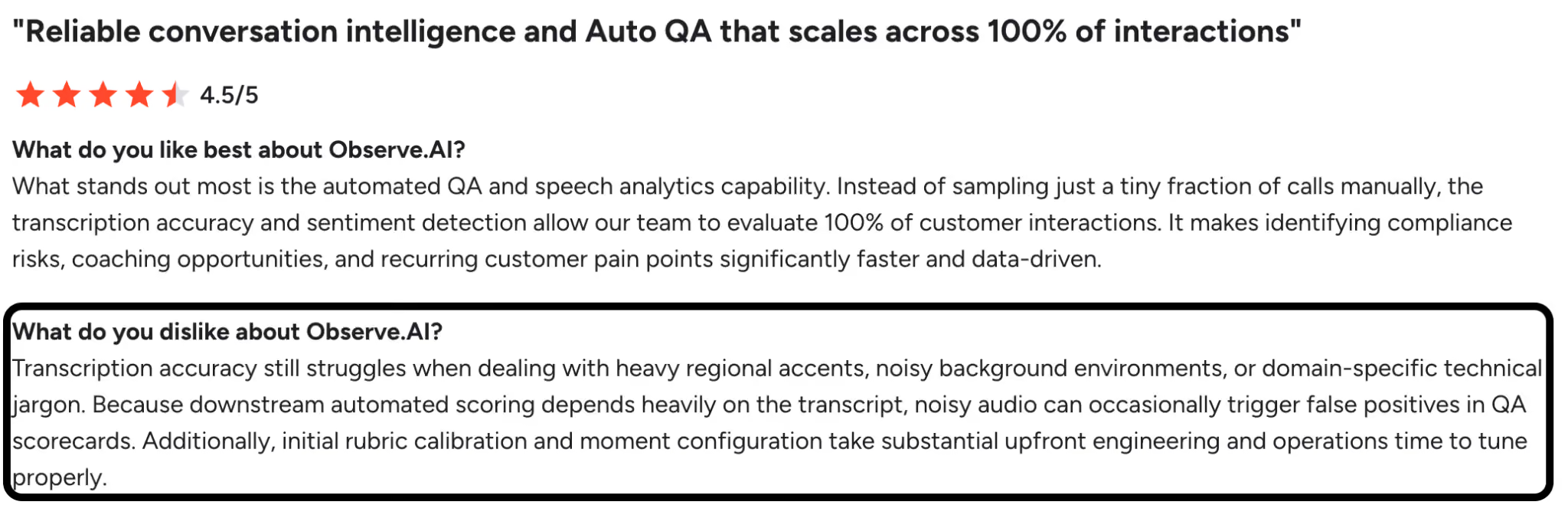
That said, users often complain about transcription and sentiment-detection accuracy. Since real-time guidance depends on having an accurate live transcript, the transcription errors can lead to missed or mistimed prompts.
Related: The top Observe.AI alternatives
How to evaluate agent assist software
Once you've narrowed down your shortlist, you can start evaluating each vendor with the criteria below.
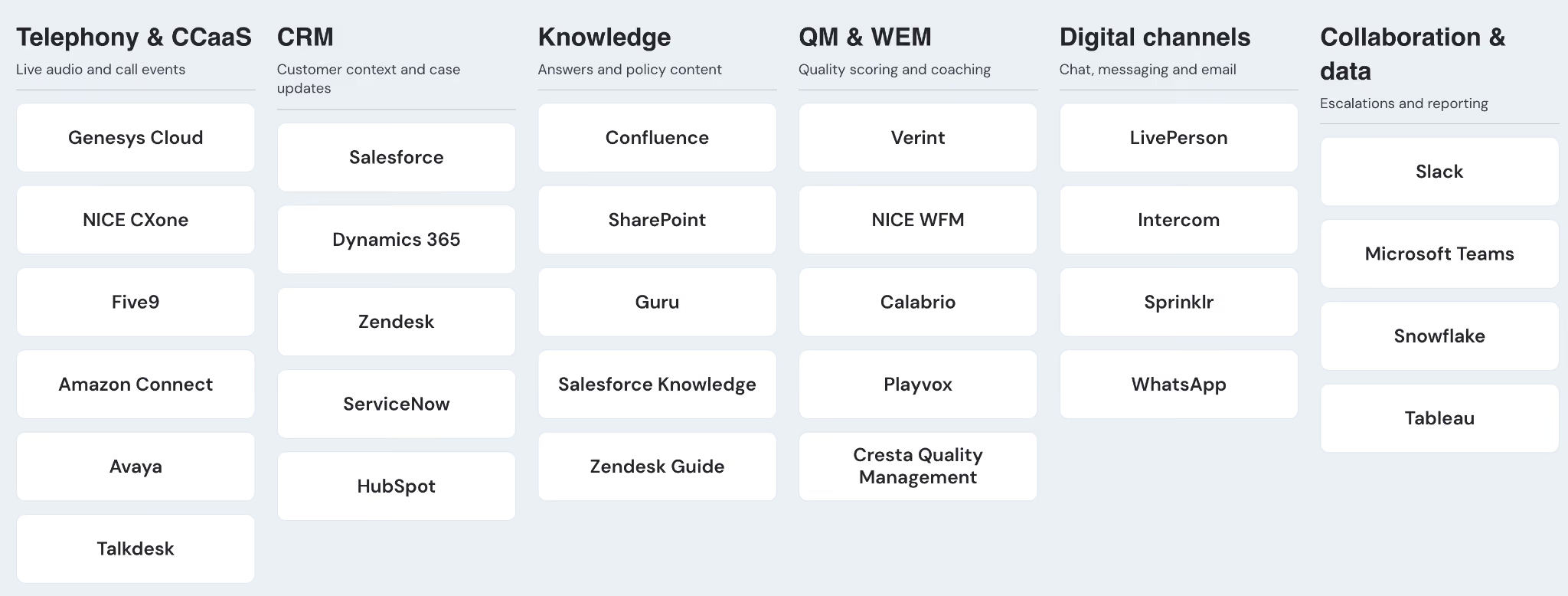
Integration architecture
Integration architecture determines whether a platform works with your existing infrastructure or forces you to replace it.
For example, CCaaS-native coaching tools from NICE and Genesys work best if you’re on that vendor’s platform. But if you use a different CCaaS, they’re harder to adopt, and switching platforms just to get coaching means a full migration.
On the other hand, specialized tools like Cresta’s Agentic Assist deploy alongside the telephony, CRM, and QM systems you have today, so you can add agent assist without replacing your platform.
In addition, you should ask each vendor which of your systems it integrates with natively and which needs custom work. Any gaps in your telephony, CRM, or QM connections show up as missing data or extra clicks for agents, and that can kill adoption.
Behavior-to-outcome correlation
Some platforms track what agents say and flag moments for supervisor review. Others go further and identify which specific agent behaviors correlate with business outcomes like CSAT, first call resolution (FCR), and sales conversion.
The difference matters.
Platforms that tie specific agent behaviors to improving metrics like CSAT can build live guidance around what actually works, then refine it as results come in. Flag-only tools leave managers guessing which behaviors matter.
Vivint, a smart home security provider handling roughly 60,000 calls per week, saw this distinction play out in practice.
In a Cresta Agentic Assist pilot, Vivint agents raised their closed-won rate by nearly 7% by accessing and using live guidance that moves the needle.
Quality management at scale
Traditional quality management programs review a small fraction of conversations. According to QM Group, that fraction is less than 2% of calls.
Platforms that score far more conversations, ideally 100%, turn quality management from a sampling exercise into an always-on view of how every agent is performing. Agents will also trust the feedback more because it reflects all of their work. And as a result, they’ll be more likely to act on the coaching.
For example, Oportun, a financial services company, moved from sample-based QA to monitoring 100% of its interactions with Cresta. This enabled their agent assist coaching to shift to the behaviors that drive results, which narrowed the gap between their top performers and the rest of the team.
Compliance monitoring
Compliance monitoring frameworks matter if your contact center handles sensitive customer data (which is likely the case).
Look for platforms that support regulations like GDPR, HIPAA, PCI-DSS, TCPA, and any industry-specific requirements. And beyond meeting regulations, evaluate for features and functionality that prevent security incidents, like role-based access controls, call encryption, audit trails, and real-time violation flagging during live interactions.
Robust pilot program
Whichever vendor you initially choose, we recommend starting a pilot with 5-10% of your agents that’s focused on one or two high-impact use cases.
This helps limit risk, surfaces integration problems early, and gives you evidence from your own calls and agents instead of relying on vendor claims.
Here are some other tips for scoping out pilots with agent assist solutions:
- Set a baseline before launch. Record current outcome metrics (e.g., CSAT, FCR) and how often agents perform the key behaviors
- Define success up front. Agree on targets and a time window, for example “FCR up 3 points in eight weeks,” so you aren’t interpreting results after the fact
- Use a matched control group. Compare pilot agents to similar agents without the tool, matched on tenure, team, and call type, so you can isolate the impact of agent assist
- Track behavior change and outcomes together. Confirm agents used the guidance and the business metric moved. If outcomes improved without behavior change, something else is the cause
Final thoughts
The best agent assist software depends on where your contact center is today.
Cresta fits teams that want real-time guidance, quality management, and coaching tied to outcome data on one platform. NICE CXone and Genesys Cloud CX fit teams already committed to those CCaaS ecosystems. Balto suits teams that want voice-first prompts without replacing existing infrastructure. And Observe.AI suits leaders who prioritize historical performance analysis and personalized coaching plans.
Whichever platforms ultimately make your shortlist, look for the same things: Native integrations with your existing telephony, CRM, and QM systems, guidance built on behavior-to-outcome analysis, quality scoring across 100% of conversations, strong compliance and security controls, and proven outcomes in a pilot.