
How to Measure the Real ROI of AI in the Contact Center
.avif)
.jpg)
- Real ROI is the total business value AI creates minus the full cost to run it, measured against a documented baseline.
- ROI spans three dimensions: cost to serve, revenue influence, and risk and quality. Cost savings is only one part.
- Activity metrics count what happened. Outcome metrics show what changed. Value can quietly decline while activity looks great.
- Set your baseline before launch. Without it, every result is an anecdote.
- Measure across every conversation, not a small sample, so ROI reflects the whole operation.
- The biggest overlooked return is quality, consistency, and compliance, unlocked by reviewing every conversation instead of a sample.
- Choose the right approach for each conversation. Some should be automated, some need a human, and some should be fixed at the root so they stop happening.
- Cresta is a Customer Experience AI platform that analyzes, automates, and augments conversations, with models trained on your own conversation data.
Most contact center leaders now face the same question from their CFO or board: was the AI worth it? It is a fair question, and it is harder to answer than it sounds.
Many teams reach for the easy number. They count how many conversations the AI handled and call it a win. But a high count does not prove value. A customer can be deflected and still leave unhappy.
This guide is for VPs of Customer Experience, VPs and Directors of Contact Center, AI transformation leaders, and COOs. If you have deployed AI or are about to, and you need to prove the return, this is written for you.
Here is what it covers: what ROI really means for contact center AI, why it is hard to measure, a step-by-step framework you can repeat, the metrics that matter, where AI belongs, the mistakes that distort the picture, and a pre-launch checklist. Cresta's view sits underneath all of it: automation alone is not enough. The right starting point is understanding what causes your conversations, then choosing the right approach for each.
What Does "ROI of AI in the Contact Center" Actually Mean?
The real ROI of AI in the contact center is the total business value it creates, the cost you save, the revenue you protect and grow, and the risk and variability you remove, minus the full cost to run it, measured against a documented baseline. It is broader than cost-cutting.
That value shows up across three dimensions: cost to serve, revenue influence, and risk and quality. If you measure only one, you undercount the return.
This is where Cresta's core belief matters. Automation alone is not enough. ROI does not start with "how much can we automate." It starts with understanding what is driving conversations in the first place, then choosing the right approach for each one.
Cost Savings Is Only One Piece
There are three ways AI creates return, and they work together.
- Cost to serve: the work removed and the time saved, such as shorter handling and lower cost per contact. Cost per contact is what it costs your business to resolve a single customer interaction.
- Revenue influence: the revenue AI helps protect and grow, from customers who stay to sales that close.
- Risk and quality: how consistently and safely conversations are handled, including compliance adherence and how customers and agents experience the interaction. Experience is often tracked through customer satisfaction score (CSAT), a rating customers give after a conversation.
Leading with cost savings alone caps the story. It also frames the contact center as a cost center to be shrunk, rather than a place where loyalty and revenue are won.
Activity Metrics vs. Outcome Metrics
These are two different things, and the difference is the heart of the ROI problem.
Activity metrics count what happened: conversations deflected, sessions completed, tasks run. Outcome metrics show what changed: the issue got resolved, the customer stayed, the sale was made.
The danger is that activity can look great while value quietly declines. You can deflect more conversations and still lose more customers if those deflected people never got a real answer.
Cresta is built to be outcome-driven. Discovery, tracking, guidance, and coaching are prioritized by their impact on real outcomes like resolution, retention, and CSAT, not by volume alone.
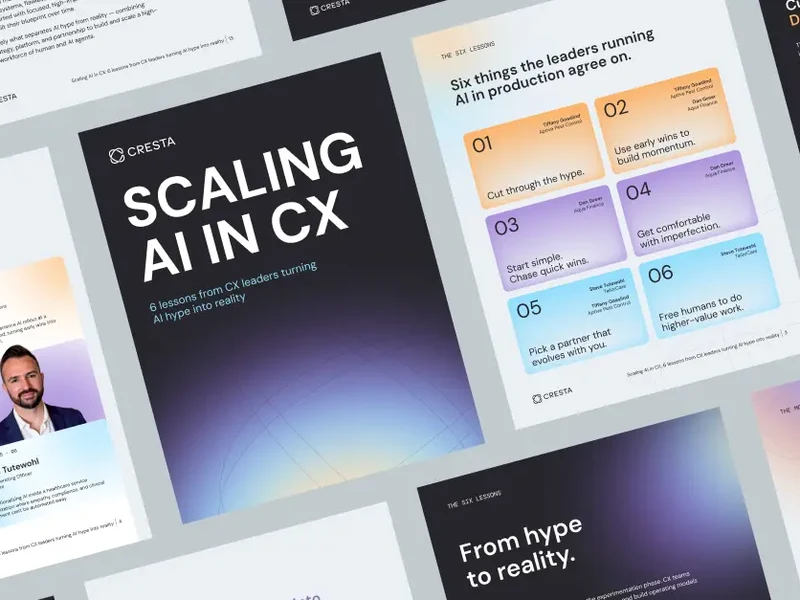
See how CX leaders have shown real value from AI at their organizations
Why AI ROI in the Contact Center Is Hard to Measure
AI reshapes how conversations happen, how agents work, and how customers feel. Because of that, its value is spread across many areas and shows up over different timeframes.
Many AI programs never prove their worth for a simple reason: no one defined "worth it" up front. When you skip that step, you are left arguing about results after the fact.
Fragmented AI Creates Data Islands
Many teams buy AI piecemeal. A chatbot from one vendor, speech analytics in a second tool, a co-pilot in a third. Each one works on its own, but none of them talk to each other.
The result is data islands. Voice metrics sit apart from chat metrics, and both sit apart from what actually happened in the operation. When the data is split like that, outcomes are disconnected from the work, and proving ROI becomes close to impossible.
To trace value, you have to follow the whole chain: from channel, to intent, to the agent or AI that handled it, to resolution, to the economic result. If any link is missing, the return leaks out where you cannot see it.
This is why a unified platform matters. Cresta runs AI Agent, Agentic Assist, and Conversation Intelligence on one layer, with a single conversation record behind every interaction. That record keeps the full chain intact, so you can connect a conversation to its cost, its revenue, and its risk instead of guessing.
Value Shows Up in Different Places and at Different Speeds
Not all returns arrive together. Labor efficiency tends to show up fast, often within the first stretch after launch. Experience and revenue effects build more slowly as habits and loyalty shift.
There is a timing trap here. Costs are mostly upfront, while many benefits accrue later. If you read ROI too early, the picture looks worse than it truly is.
Most Teams Measure a Sample, Not the Whole Picture
Traditional quality programs score a small sample of conversations by hand. That leaves most of what happened invisible, so ROI becomes a guess built on a sliver of evidence.
Cresta's Conversation Intelligence analyzes every conversation, not a sample. Conversation Intelligence is the analysis layer that scores and understands each interaction. Seeing all of them is what makes ROI credible at the population level, rather than anecdotal.
A Step-by-Step Framework to Measure AI ROI
The rest of this is a repeatable framework any team can follow. The key idea: decide how you will measure before launch, so you are not arguing about it afterward.
Step One - Set the Baseline Before You Launch
Before AI goes live, capture current performance for each metric that matters. This is your baseline, the "before" picture you will compare against.
Two metrics belong here early. Average handle time (AHT) is how long a typical conversation takes from start to finish. First contact resolution (FCR) is the share of issues solved in a single interaction, without the customer coming back.
Without a baseline, every later result is an anecdote. And if your baseline data is missing or you do not trust it, that is itself a finding worth acting on.
Step Two - Choose Metrics Tied to Business Outcomes
Pick a small set of metrics that connect to outcomes leaders care about: resolution, retention, revenue, and CSAT. Give each one a named owner.
Resist the urge to track everything. A long dashboard nobody acts on is not measurement, it is noise.
Cresta's Outcome AI helps here by prioritizing what to track based on business impact, so your attention goes to the metrics that move outcomes.
Step Three - Account for the Full Cost
The cost of AI is more than the license. Include the build, the integration work, the data preparation, the ongoing tuning, and the governance that keeps it safe.
A project priced as a one-time build is mispriced. AI that is never revisited tends to decay, and a decaying system quietly erases the return you counted on.
Step Four - Translate Metrics Into Money
Each metric needs a bridge to business value, or leaders cannot compare it to cost. Do this with simple, defensible assumptions.
On the cost side, connect the metric to work removed, such as time saved per conversation turned into freed capacity. On the revenue side, connect it to business retained or won, such as customers who stayed or sales that closed.
A defensible range that you can explain beats a precise-looking figure you cannot defend. Agree on the method with finance so the translation holds up under scrutiny.
Step Five - Review on a Regular Cadence
ROI is not a one-time calculation. It compounds or decays depending on whether someone keeps reviewing conversations and tuning the AI.
Treat the AI like a managed part of the operation, reviewed on a regular schedule, not a project you finish and walk away from.
This is where Cresta's closed loop pays off. One conversation record powers live guidance, quality scoring, and coaching, so insight feeds action and action feeds insight. That loop is what lets ROI compound over time.
The Metrics That Matter (and What Each One Tells You)
Below is a compact reference for the core metrics leaders track, grouped by what they reveal. No single metric proves ROI. Read them together.
Efficiency Metrics
Efficiency metrics tell you how much work and cost you are removing. AHT and cost per contact are the classics, and containment (also called deflection) measures the share of conversations handled without a human agent.
These matter, but they have a blind spot. A conversation can be contained and still fail the customer. A deflected but frustrated customer is not a win, so never read efficiency metrics on their own.
The goal of self-service is not maximum containment. It is healthy containment: the share you can hand to automation while first contact resolution and CSAT hold steady or improve. Containment that quietly pushes unresolved customers away is a cost, not a saving, and it will surface later in retention.
Quality and Experience Metrics
Quality and experience metrics link automation to loyalty and retention. FCR shows whether you actually solved the problem. CSAT captures how satisfied the customer felt. Customer effort captures how hard it was for them to get help.
Together, these connect the way a conversation went to whether the customer comes back. That connection is where a lot of the real financial return lives.
Agent Experience Metrics
There is a shift that surprises many leaders. When AI removes the easy, routine work, the conversations left for humans get harder on average.
That makes agent engagement a leading indicator of customer outcomes, not a soft afterthought. Tired or disengaged agents show up later in CSAT and retention.
A co-pilot is not only a productivity tool. Agent Assist reduces variability by delivering the same guidance and knowledge to every agent in the moment, so the average agent performs closer to your best. It also shrinks ramp-up time for new hires, because the guidance travels with the conversation instead of living in a manual.
Cresta augments agents rather than replacing them, and it measures the human and AI operation together. Because guidance, quality management, and coaching run off the same conversation record, agent experience is part of the ROI picture, not separate from it.
The Overlooked Return: Quality, Consistency, and Compliance
Most ROI conversations stop at cost and revenue. The largest and most ignored return is often quality, consistency, and compliance. It hides in plain sight because it is hard to see when you only review a sample.
Here is the shift. Traditional quality programs audit a tiny slice of conversations by hand, so most of what happens on the floor is never seen. Cresta's Conversation Intelligence reviews every conversation automatically, which turns quality from a sample into full coverage. That change is where the value comes from.
- Key point: Lower QA cost. Automated review across every interaction removes most of the manual auditing work, so quality coverage goes up while the cost of running it goes down.
- Key point: Reduced compliance risk. When every conversation is checked, missed disclosures and off-script moments surface instead of hiding in the conversations no one sampled.
- Key point: Less variability and rework. Catching tone and process issues in the moment, rather than days later, means fewer repeat contacts and less cleanup after the fact.
- Key point: Systematic replication. Seeing every conversation lets you identify what your top performers actually do, then spread those behaviors across the floor through coaching and behavioral recognition.
This is why quality belongs in the ROI model, not beside it. Quality Management scores conversations automatically, and coaching turns those findings into the behaviors that move outcomes. Measured this way, consistency and compliance stop being a cost of doing business and become a source of return.
Where AI Belongs (and Where It Does Not)
Measuring ROI well means being honest about where AI should and should not go. The smartest way to frame it is to sort conversations by what is causing them, then choose the right approach for each. Conversations fall into four buckets.
- Conversations that should not have happened. These come from systemic issues that confuse customers at scale. The highest-return move is to fix the root cause so the contacts disappear, not to put an AI Agent on them as an expensive band-aid.
- Conversations neither party wants to have. Routine interactions with a clear goal, where the fastest path is automation. This is where AI Agent shines. AI Agent handles autonomous voice and digital conversations end to end.
- High-emotion, high-value conversations. Moments that need a human. Here AI helps behind the scenes, pulling context and guiding the agent through Agentic Assist, which delivers real-time guidance and knowledge to human agents.
- Conversations that should happen but do not. Proactive touchpoints like outreach and reminders that are not feasible at human scale. AI makes them economical.
Forcing AI into the wrong bucket destroys ROI. Automating a conversation that should never have happened just makes a bad interaction cheaper, when the real win was removing it entirely.
Common Mistakes That Distort AI ROI
These are the errors that make AI ROI look better or worse than it really is.
- Key point: Measuring only automation or containment. Counting deflected conversations ignores whether customers were actually helped, so it flatters the numbers while missing value that leaked away.
- Key point: Skipping the baseline. With no "before" picture, you cannot prove what changed, and results become opinion.
- Key point: Ignoring adoption and change management. AI that agents do not trust or use returns little, no matter how capable it is.
- Key point: Treating ROI as one-time. A single calculation at launch misses the decay that sets in when no one tunes the system.
- Key point: Ignoring agent experience. When the easy work is gone, agent strain shows up later as lower CSAT and higher attrition.
- Key point: Trusting generic vendor benchmarks over your own data. A number from someone else's contact center rarely reflects your customers, your products, or your operation.
That last point is where Cresta differs by design. Cresta's models are trained on each customer's own conversation data, not generic inputs. Measurement should reflect how your business actually runs, not a benchmark borrowed from elsewhere.
A Pre-Launch Checklist for Measurable AI ROI
Work through this before AI goes live. Each item removes an argument you would otherwise have later.
- Baseline captured for every metric that matters.
- One to a few outcome metrics chosen, each with a named owner.
- Full cost modeled, including build, integration, data work, tuning, and governance.
- Dollar translation method agreed with finance.
- Review cadence set on a regular schedule.
- A plan to measure across all conversations, not a sample.
- Agreement on where AI will and will not be used.
Conclusion
Real ROI is outcome value minus full cost, measured against a baseline, across every conversation, and reviewed over time. That is the whole framework in one line.
It helps to name what this really is. AI in the contact center is not a technology project. It is an operational instrumentation project. The teams that win are the ones who can measure, inside one operating system, exactly how AI changes cost, revenue, and risk.
The decision guidance is just as simple. The teams that decide what "worth it" means before launch, and that measure the whole operation rather than a slice of it, are the ones who prove the return and then grow it. Automation alone is not the goal. Choosing the right approach for each conversation is.
Cresta is dedicated to helping businesses of all sizes make informed decisions. We adhere to strict editorial guidelines to ensure that our content meets and maintains our high standards.